
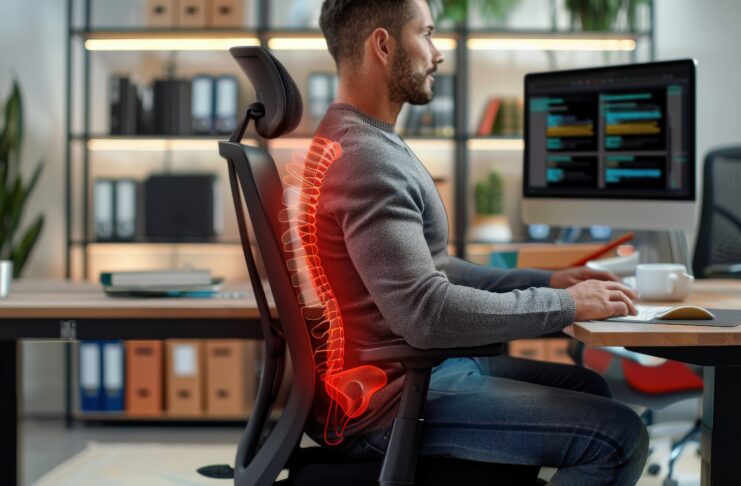
Back pain is now the leading cause of disability worldwide, with adults aged 25 to 45 representing the fastest-growing demographic for new chronic back pain diagnoses — driven primarily by desk-based sedentary work and sustained screen exposure.
Prolonged sitting in a forward-flexed posture increases compressive load on lumbar spinal discs by up to 140% compared to upright standing — with sustained disc compression directly associated with progressive disc dehydration, structural change, and eventual herniation risk.
MRI studies of asymptomatic adults in their late twenties and early thirties — individuals with no back pain at all — reveal early disc degeneration in a significant proportion, confirming that structural spinal damage routinely precedes symptoms by a decade or more.
Right now, in this moment, your spine is probably not in a neutral position. Your head is likely drifting forward of your shoulders by several centimetres. Your upper back is rounding. Your lower back is either collapsed into flexion or excessively extended. Your hip flexors are shortened. Your gluteal muscles are switched off. And none of this is producing any pain — which is exactly the problem. The spinal damage that produces chronic back pain, disc herniation, and significantly reduced quality of life in people in their forties and fifties is not created by a single incident. It is created by the accumulation of thousands of hours in precisely this position, with postural deviations that the body can compensate for — right up until the moment it cannot.
What Is Happening to Your Spine
The intervertebral discs — the shock-absorbing structures between each vertebra — have no direct blood supply. They are nourished through a process called imbibition: as the spine moves through its natural range of motion, fluid is drawn into and expelled from the disc, delivering nutrients and removing metabolic waste. This mechanism depends entirely on movement. Prolonged static sitting in a flexed posture compresses the anterior disc space continuously, prevents the fluid exchange that maintains disc hydration and integrity, and places sustained tensile load on the posterior annulus fibrosus — the outer ring of the disc — in a position it was not designed to sustain for hours at a time.
Over months and years, this produces progressive disc dehydration, loss of disc height, and the micro-tears in the annular fibres that precede disc bulging and herniation. Simultaneously, sustained postural loading creates a predictable and well-documented cascade of muscle imbalance: the hip flexors shorten adaptively; the gluteal muscles become inhibited and functionally weak; the deep core stabilisers — the multifidus and transversus abdominis — are not meaningfully activated during passive sitting and atrophy with disuse; the thoracic extensors become chronically lengthened and fatigued; the pectorals and anterior shoulder musculature tighten. The cervical spine develops the characteristic forward head posture — for every inch the head moves forward of neutral, the effective load on the cervical spine approximately doubles, producing the neck pain, upper trapezius tension, and cervicogenic headaches that are endemic in desk-working adults in their late twenties and thirties.
Why This Age Group Is the Critical Window
Spinal damage is structurally silent in its early stages because cartilage — including disc material — has no nerve supply. The first sensation of pain is not the first moment of injury. It is the moment at which structural change has advanced sufficiently to begin affecting the pain-sensitive structures surrounding the disc: the posterior longitudinal ligament, the nerve roots exiting the spinal canal, the vertebral endplates, the facet joint capsules. By the time pain arrives, the structural change causing it has typically been developing for years. The late twenties and early thirties represent the period when this damage is actively being laid down — when the structural trajectory of the spine across the following decades is being set — and when it is still entirely reversible with the right intervention.
⚠️ Warning Signs to Watch For
- Lower back stiffness or achiness upon waking that takes more than 10 to 15 minutes to resolve — a marker of disc-level irritation accumulating from sustained daily loading
- Neck pain, upper trapezius tension, or base-of-skull headaches that build predictably through screen-heavy working days and are temporarily relieved by movement
- Referred pain, tingling, or numbness tracking from the lower back into one or both legs, or from the neck into the arms or hands — potential indicators of nerve root irritation from disc pathology requiring professional assessment
- An inability to sit comfortably for more than 20 to 30 minutes before needing to shift, adjust, or stand — a sign that the structural compensation limit is already being regularly exceeded
- Visible postural change over recent years: photographs comparing your standing posture from two to three years ago with today that show increased upper back rounding or forward head position
- Recurrent acute episodes of back pain from seemingly minor movements — bending to pick something up, sneezing, twisting — that should not produce significant pain in a structurally healthy spine
- Hip flexor tightness significant enough to affect walking pattern, sleeping position comfort, or the ability to stand fully upright with a neutral pelvis
What Exercise and Lifestyle Changes Actually Help
The most evidence-backed intervention for desk-induced spinal damage is not a special chair, a standing desk, or a monthly massage — though each has a role. It is movement frequency: interrupting static postures before they accumulate sufficient load to produce structural change. Research consistently identifies two minutes of movement every 30 to 45 minutes as the minimum effective dose for maintaining disc hydration, preventing the gluteal inhibition that shifts spinal load to passive structures, and interrupting the continuous muscle imbalance that postural syndrome creates. A standing desk helps if used variably — alternating between sitting and standing — but static standing for long periods creates its own biomechanical problems and is not a substitute for movement.
Targeted exercise addresses the muscle imbalances that sustained sitting creates. The evidence-based priorities are threefold. First, strengthening the posterior chain — the glutes, hamstrings, thoracic extensors, and deep cervical flexors — which become inhibited and weak with prolonged sitting and are the primary dynamic stabilisers of the spine under load. Second, restoring mobility to the hip flexors and thoracic spine, both of which progressively stiffen with sustained flexion and whose restriction forces compensatory movement through the lumbar spine, where it is most damaging. Third, rebuilding deep core stability — through exercises including dead bugs, bird dogs, and Pallof presses — which restores the deep stabilisation system that passive sitting entirely bypasses and that is fundamental to spinal load management.
✅ Action Plan Checklist
- Set a movement reminder for every 30 to 45 minutes during your working day — two minutes of movement at this frequency is more effective for disc health than 60 minutes of exercise at the end of the day
- Audit your workstation: screen at direct eye level, monitor approximately arm’s length away, keyboard positioned so elbows sit at 90 degrees, lumbar support that maintains — not forces — the natural lumbar curve
- Begin a daily 10-minute mobility routine targeting hip flexors, thoracic spine rotation, and hamstring length — this single consistent habit produces measurable postural change within six to eight weeks
- Add glute activation work three times weekly: hip thrusts, single-leg deadlifts, clamshells, and lateral band walks are all highly accessible and directly address the inhibition that desk work creates
- Learn and practise the dead bug exercise as your foundational deep core stability work — it is the most accessible and clinically validated exercise for restoring lumbar stabilisation without loading the spine
- If you have neck pain, referred arm symptoms, or headaches that do not resolve with two weeks of consistent movement intervention, see a physiotherapist for a structural assessment — cervical disc issues benefit considerably from early manual therapy
- Avoid stomach sleeping if you experience neck pain — maintaining the cervical spine in sustained end-range rotation for six to eight hours each night is a significant driver of cervicogenic symptoms
The Breathing and Spinal Stability Connection
There is a dimension of spinal health that almost never appears in mainstream posture conversations: the role of breathing mechanics in deep core function. The diaphragm — the primary breathing muscle — is anatomically inseparable from the deep core stabilisation system. It forms the top of the intra-abdominal pressure canister whose integrity — alongside the pelvic floor below and the transversus abdominis around the circumference — is fundamental to spinal stability under load. When thoracic posture collapses and the ribcage drops, diaphragm excursion is mechanically restricted, accessory breathing muscles in the neck and upper chest compensate, and deep core activation is progressively compromised. The chronic neck tension and upper trapezius tightness that desk workers carry is partly a postural problem and partly a breathing mechanics problem. Practising diaphragmatic breathing — slow, three-dimensional breaths that expand the lower ribcage in all directions rather than lifting the chest — restores the mechanical prerequisite for both genuine core stability and relief of the secondary muscle tension that restricted breathing creates.
Bottom Line
The spinal damage accumulating in your late twenties and early thirties is silent, structural, and — at this stage — entirely reversible. The daily habits that prevent it are not complicated or time-consuming: they require only the understanding that a body designed for continuous movement cannot be sustained in static postures for most of its waking hours without consequence. Move more, move often, strengthen what sitting has switched off, and restore mobility to what it has shortened. Your spine at 50 will directly reflect the choices your spine is experiencing right now.

