
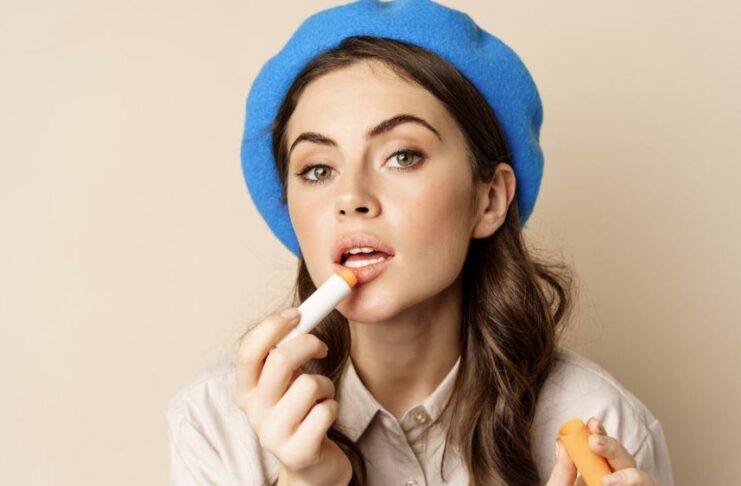
The product you rely on daily may be quietly accelerating volume loss in the one feature that ages you fastest.
KEY STATISTICS
- Lip skin is 3–5 times thinner than facial skin and loses collagen at a measurably faster rate after age 35.
- Studies on occlusive skincare ingredients show prolonged use can reduce the skin’s own natural moisturizing factor (NMF) production by up to 30%.
- By age 40, most adults have lost approximately 10% of their lip volume — a process that accelerates with repeated use of barrier-suppressing topicals.
You reach for it first thing in the morning, again after lunch, and once more before bed — and your lips still feel dry the moment you stop. That cycle is not a coincidence. The very ingredient keeping your lips comfortable may be training them to stop moisturizing themselves.
What Occlusives Actually Do
Lip skin contains almost no sebaceous glands, which means it produces very little of its own protective oil barrier. It relies instead on a complex process involving natural moisturizing factors — amino acids, ceramides, and lipids produced within the skin cells themselves — to retain water and maintain suppleness.
When you apply an occlusive product like petrolatum, mineral oil, or dimethicone, you create an external seal over the lip surface. That seal works in the short term, locking in existing moisture effectively.
The problem is what happens underneath that seal over time. The skin’s moisture-sensing mechanisms detect hydration at the surface and interpret it as a signal that internal production is no longer needed. Research on occlusive skincare suggests this feedback loop gradually reduces the skin’s own lipid synthesis — a process dermatologists refer to as lazy skin response.
For lip skin specifically, this matters more than it does on the cheek or forehead. The dermis beneath the lip surface is already sparse in structural support, and any reduction in cellular activity compounds the volume and definition loss that begins in your mid-thirties.
Why 35 Changes Everything
After 35, hyaluronic acid production in the lip area slows noticeably. The vermillion border — the defined edge that separates lip from skin — begins to blur, and the philtrum columns above the upper lip start to flatten.
Estrogen plays a significant role here. It stimulates collagen production and helps maintain the density of connective tissue that gives lips their rounded, lifted shape. As estrogen levels begin to fluctuate through perimenopause and beyond, that structural scaffolding weakens.
This is precisely the age at which most people increase their use of lip balm. Dryness and flaking become more common as the skin’s own repair capacity slows, so the instinct is to apply more product more frequently. That well-intentioned habit, repeated daily for years, compounds the suppression effect at the exact time when the lip area can least afford it.
Signs Your Lips Depend
- You need to reapply lip balm within 30–60 minutes of each application just to feel comfortable — this suggests dependency, not hydration
- Your lips feel significantly drier and more irritated on the rare days you skip your usual balm
- The edge of your upper lip looks less defined than it did a few years ago, even without obvious weight change
- You notice fine vertical lines forming on the lip surface that weren’t there in your early thirties
- Your lips feel rough and flaky in the morning despite applying a thick balm the night before
What Actually Helps Instead
The first and most important shift is switching from occlusive balms to humectant-based formulas. Ingredients like hyaluronic acid, glycerin, and aloe vera draw moisture into the skin cells rather than sealing over the surface. They support the skin’s own hydration mechanism instead of replacing it.
If you have been using a petroleum-based product for years, do not stop abruptly. Wean off gradually over two to three weeks while introducing a humectant alternative, allowing your skin’s natural moisture response time to reactivate.
Diet supports lip skin health from the inside. Omega-3 fatty acids — found in oily fish, flaxseed, and walnuts — directly support the lipid matrix within skin cells. Vitamin E and zinc both play roles in skin membrane integrity and are commonly low in adults over 35 who eat a processed-food-heavy diet.
Sun exposure is one of the most underestimated accelerants of lip volume loss. The upper lip in particular receives direct UV exposure that breaks down collagen in the vermillion border. A lip product with SPF 30 or higher worn daily — ideally one using zinc oxide rather than chemical filters — offers meaningful protective value.
Your Lip Reset Plan
- Audit your current lip balm: if the first three ingredients include petrolatum, mineral oil, or dimethicone, begin transitioning to a humectant-based alternative this week
- Apply your new lip product to slightly damp lips — press a damp fingertip to your lips first — to maximise water absorption before sealing
- Add one omega-3-rich food daily: a small handful of walnuts, a tablespoon of ground flaxseed, or one portion of oily fish supports skin lipid production from within
- Use an SPF 30+ lip product every morning before leaving the house, even in winter — UV damage to the vermillion border is cumulative and largely irreversible
- Give your lips one completely product-free hour each morning before applying anything, allowing the surface to breathe and natural sebum-adjacent processes to activate
The Overnight Factor Nobody Mentions
There is one factor almost nobody connects to lip thinning: habitual mouth breathing, particularly during sleep. When air passes over the lip surface repeatedly through the night, it strips surface moisture faster than the skin can replenish it.
This leaves lips in a state of chronic low-level dehydration each morning, which is often what drives the heavy overnight balm habit in the first place. If you regularly wake with cracked or peeling lips despite nightly application, nasal congestion or sleep-disordered breathing may be the root cause — not a product deficiency.
Addressing nasal breathing through a healthcare provider, and using a humidifier in the bedroom set to 40–50% humidity, can make a measurable difference to lip condition overnight. This removes the need for heavy occlusive products and allows the skin to regulate its own moisture balance while you sleep.
Bottom Line
Your lip balm habit is not wrong — but the formula likely is. Switching from occlusive to humectant-based products, supporting skin from within through diet, and addressing overnight dehydration gives your lips the conditions they need to maintain their own hydration and slow the volume loss that accelerates after 35.
Always consult a qualified healthcare provider before making changes to your health routine.
Sources
- Natural moisturizing factors and their role in skin hydration and barrier function — Journal of Investigative Dermatology
- Occlusive agents and feedback inhibition of endogenous lipid synthesis in human skin — British Journal of Dermatology
- Age-related changes in lip morphology and perioral tissue volume — JAMA Facial Plastic Surgery
- Estrogen and collagen biosynthesis: implications for skin aging in perimenopausal women — Menopause: The Journal of The Menopause Society

