
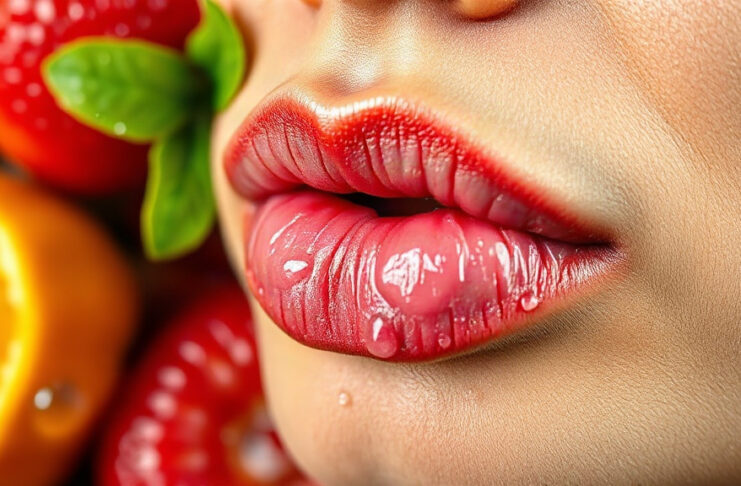
Your lips are the earliest warning system your body has — and most people ignore them completely.
KEY STATISTICS
- **The lip dermis is up to 5 times thinner than skin on the cheeks, making it one of the most dehydration-sensitive tissues on the face.**
- **Research published in Skin Research and Technology found that transepidermal water loss (TEWL) is measurably higher in lip tissue than in any other facial zone.**
- **A 2021 dermatology review found that adults between 35 and 45 experience a 20–25% decline in skin surface hydration compared to their mid-twenties baseline.**
You drink your eight glasses, you apply your moisturiser, and yet your lips still look creased, deflated, and somehow older than the rest of your face. That is not a cosmetic problem — it is a physiological one. Lip tissue is structurally unlike skin anywhere else on your body, and cellular dehydration shows up there first, often years before it becomes visible on your cheeks or forehead.
Why Lips Lose Moisture
Lip tissue lacks the sebaceous glands found across the rest of the face, which means it produces no protective sebum layer to slow moisture loss. Without that lipid barrier, water evaporates directly from the mucosal surface at a rate that dermatologists now measure using a specific marker called transepidermal water loss, or TEWL.
When your cells are even mildly dehydrated — not dramatically, just chronically under-hydrated — the lip dermis is the first zone to contract visibly. The vermilion border, that defined edge between your lip and surrounding skin, begins to blur. Fine vertical lines appear not because of sun damage or age, but because the tissue literally lacks the water volume to stay plump.
Dermatologists increasingly use lip tissue assessment as one of three core hydration markers alongside skin turgor testing and capillary refill time. These markers together paint a clearer picture of cellular hydration status than a blood test can at mild dehydration levels. Your lips, in short, are a live diagnostic panel.
Why Your 30s Accelerate This
Between 35 and 45, two hormonal shifts start working against your skin’s ability to retain water. Estrogen, which directly stimulates hyaluronic acid production in the dermis, begins a gradual decline. Hyaluronic acid is the molecule responsible for binding and holding water inside skin cells, and as its production drops, the skin’s reservoir capacity shrinks.
The lips are hit disproportionately hard because their thin dermis depends almost entirely on this internal moisture rather than surface oils. At the same time, collagen synthesis slows by roughly 1% per year after 30, and collagen degradation speeds up. This combination means the structural scaffold that holds lip tissue firm begins to collapse faster than it is being rebuilt.
Caffeine consumption, which tends to rise during the high-stress career and parenting years of the 35–45 window, adds another layer of risk. Caffeine is a mild diuretic that increases urinary water loss, subtly drawing down the hydration reserves that lip tissue depends on most.
Warning Signs To Watch
- Vertical lip lines that appear even when your face is relaxed and your lips are closed — these are not expression lines, they are dehydration lines
- A blurred or softened vermilion border, the defined edge where your lip meets surrounding skin, which loses crispness as lip tissue deflates
- Lips that feel tight or uncomfortably dry within an hour of applying balm, suggesting the underlying tissue lacks moisture rather than just the surface
- A dull, flat lip colour that looks washed out or greyish even when you are not ill — dehydrated tissue loses its microcirculation vibrancy
- Peeling that recurs weekly despite regular exfoliation, which signals the cellular turnover rate is outpacing the tissue’s ability to stay hydrated enough to shed cleanly
What Actually Helps
The single most effective intervention dermatologists recommend is front-loading water intake in the morning rather than spacing it evenly through the day. Overnight, the body enters a mild dehydration state regardless of how well you hydrated the day before, and lip tissue — with its high TEWL rate — wakes up already depleted.
Drinking 400–500ml of water within thirty minutes of waking gives your cells the first opportunity to rehydrate before cortisol and caffeine begin driving water loss. Pairing that morning water with a small amount of sodium — a pinch of sea salt or an electrolyte supplement — significantly improves cellular uptake compared to plain water alone.
For topical support, dermatologists now recommend products containing both humectants and occlusives applied in sequence. A humectant like hyaluronic acid draws water into the tissue, while an occlusive like shea butter or squalane seals it in by mimicking the sebum barrier that lips naturally lack. Applying this combination before bed, when skin repair peaks, produces measurably better results than daytime-only application.
Diet also plays a direct role. Foods with high water content — cucumber, watermelon, celery, and cooked oats — contribute meaningfully to cellular hydration in ways that plain water alone does not replicate, because they deliver water alongside electrolytes and fibre that slow absorption and improve retention.
Your Hydration Action Plan
- Drink 400–500ml of water with a pinch of sea salt or an electrolyte tablet within 30 minutes of waking, before coffee or tea
- Apply a hyaluronic acid serum to lips first, wait 60 seconds, then layer a shea butter or squalane-based balm on top to lock moisture in
- Reduce caffeine to no more than 2 cups per day and offset each cup with an additional 200ml of water to counteract its diuretic effect
- Add two high water-content foods to your daily diet — cucumber, watermelon, or cooked oats are the most bioavailable sources for skin hydration
- Check your lips each morning before applying anything — track changes in the vermilion border, surface texture, and colour as a simple daily hydration audit
The Overlooked Air Factor
The factor most people never connect to lip dehydration is indoor air quality — specifically, the humidity level of the environments where you spend the most hours. Heating systems in winter and air conditioning in summer both strip ambient humidity, often dropping it below 30%, which is the threshold at which visible TEWL from lip tissue accelerates significantly.
A small-room humidifier set to maintain 45–55% relative humidity, particularly in your bedroom overnight, has been shown in dermatology literature to reduce TEWL and improve skin barrier function over a four-week period. This is one of the most underused tools in at-home skin hydration management, and it costs less than most serums.
Breathing through the mouth, whether due to nasal congestion, stress, or habit, dramatically increases moisture loss from lip tissue because it bypasses the nasal passages that warm and humidify incoming air. If you notice your lips are consistently worse in winter or after illness, mouth breathing is likely accelerating the dehydration your environment is already causing.
Bottom Line
Your lips are not aging — they are dehydrating, and the difference matters because dehydration is reversible while structural aging is not. Front-load your water intake, build a two-step topical routine, and take your indoor air seriously. Act on what your lips are already telling you.
Always consult a qualified healthcare provider before making changes to your health routine.
Sources
- Transepidermal water loss as a measure of skin barrier function — Skin Research and Technology
- Age-related changes in skin hydration and barrier function — Journal of Investigative Dermatology
- Hyaluronic acid and skin hydration: clinical evidence and mechanisms — Journal of Clinical and Aesthetic Dermatology
- Estrogen and skin: the effects of estrogen on skin aging and its clinical implications — American Journal of Clinical Dermatology
- Indoor humidity levels and skin barrier integrity: a controlled study — British Journal of Dermatology

