
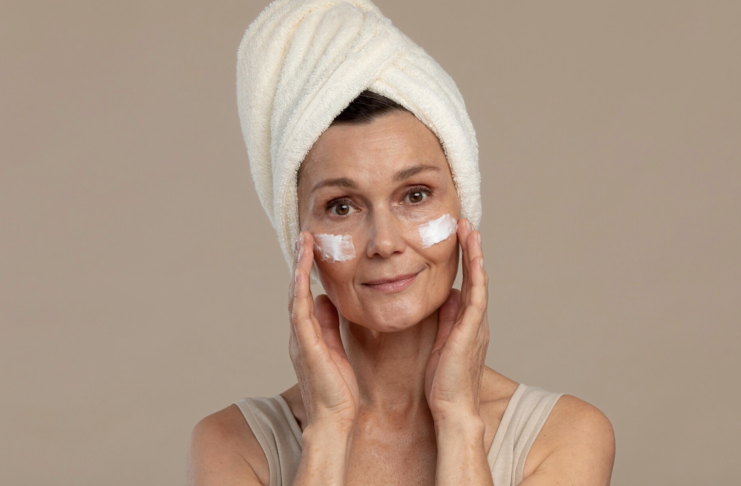
The way you’re applying your tinted moisturizer could be adding years to your face instead of erasing them.
KEY STATISTICS
- A 2021 survey by the NPD Group found that over 60% of women aged 35–50 report their base makeup settles into fine lines within two hours of application.
- Skin loses approximately 1% of its collagen per year after age 30, causing surface texture changes that directly affect how pigmented products sit on the face.
- Dermatologists note that oxidation — the chemical reaction between skin oils and foundation pigments — affects up to 70% of women who skip a pH-balancing primer before application.
You switched from heavy foundation to tinted moisturizer because it was supposed to look more natural — lighter, fresher, more you. But if you’re applying it the same way you applied foundation at 25, you’re likely watching it crease into your smile lines by noon and turn slightly orange by 3pm. The product isn’t the problem.
The technique is.
Why It Creases and Oxidizes
Tinted moisturizer is designed to be a sheer, skin-enhancing product — but its lightweight formula is precisely what makes it vulnerable to disruption on mature skin. Unlike full-coverage foundation, it lacks the film-forming polymers that help it grip the skin’s surface, which means it migrates easily into any texture it encounters.
When tinted moisturizer meets a fine line, it flows into the crease and pools, catching light in a way that actually deepens the appearance of that line. This is called physical settling, and it happens faster on skin that has lost elasticity and natural moisture retention.
Oxidation is the second problem. The iron oxide pigments in most tinted moisturizers react with sebum and skin acids throughout the day, shifting the product’s tone darker or warmer. On mature skin — which often has a more acidic pH than younger skin — this color shift can be dramatic and unflattering.
Why Your Decade Changes Everything
Between the ages of 35 and 45, the skin undergoes structural changes that make it uniquely incompatible with casually applied tinted moisturizer. Collagen and elastin decline accelerates, and the skin’s surface becomes less uniform — with dry patches, enlarged pores, and fine lines appearing in close proximity to each other.
The skin’s natural moisture barrier also becomes less efficient during this decade, meaning tinted moisturizer can dehydrate the skin beneath it rather than supplement it. When skin is pulled tight over dehydrated tissue, any product sitting on top of it moves and creases more aggressively.
Hormonal fluctuations common in the 35–45 age range — particularly declining estrogen — change both skin texture and sebum production patterns. Some areas of the face become drier while others become oilier, creating uneven zones that cause tinted moisturizer to look patchy and inconsistent by midday.
Warning Signs To Watch
- Your tinted moisturizer looks noticeably darker or more orange within 2–3 hours of application
- You can see the product visibly pooled in fine lines around your mouth, eyes, or forehead by noon
- Your skin looks dull or flat rather than glowing after application, even though the product claims a luminous finish
- You notice dry patches where the product has clung to flaking skin, creating a textured, uneven appearance
- Your skin feels tight or dehydrated an hour after application, suggesting the formula is pulling moisture rather than adding it
Technique Changes That Actually Work
The single most impactful change you can make is to prep your skin’s surface before any pigmented product touches it. Apply a thin layer of hydrating serum — one containing hyaluronic acid or glycerin — and let it absorb for 60 seconds before your tinted moisturizer. This creates a slippery, hydrated surface that prevents the product from gripping and pooling in fine lines.
Blending technique matters more than most people realise. Use a damp beauty sponge rather than fingertips or a brush — fingers deposit too much product in one spot and drag on mature skin, while brushes can disturb the moisture barrier. A damp sponge stipples the product onto the skin in a bouncing motion, pressing it into the surface rather than sliding it across it.
Shade matching is not optional. Have your tinted moisturizer colour-matched in natural light, not store lighting. Choose a shade that matches your neck, not your face, to avoid the oxidation problem appearing as a visible line at your jawline by afternoon.
Set the product strategically, not all over. A light dusting of translucent powder in the T-zone — particularly in the areas where you experience most movement and oiliness — will lock the product in place without the powdery, flat look that can age the skin around the eyes and mouth.
Your Application Action Plan
- Apply a hyaluronic acid serum and wait 60 seconds before adding any tinted moisturizer
- Use a damp beauty sponge in a stippling motion — never drag the product across the skin
- Get your shade matched in natural daylight and always match to your neck, not your cheekbone
- Set only the T-zone with translucent powder; leave the cheeks and under-eye area untouched
- Midday, refresh with a facial mist rather than blotting — blotting physically disrupts the product and deepens creasing
The Skin Temperature Problem
The overlooked factor in how tinted moisturizer ages you is skin temperature. Many people apply their morning skincare while their face is still slightly flushed from hot water or steam — and warm, dilated pores absorb product differently than settled, room-temperature skin.
When pores are open and skin is warm, tinted moisturizer sinks unevenly — absorbing deeply in some areas while sitting on the surface in others. This uneven absorption is what creates the streaky, patchy finish that appears before you’ve even left the house.
Wait five to ten minutes after cleansing or any warm water contact before applying your tinted moisturizer. Use this time to mist your face with a cool facial spray, which gently closes pores and creates a smooth, even-temperature canvas that holds product more consistently throughout the day.
Bottom Line
Tinted moisturizer is one of the most forgiving, skin-friendly products available for women in their 35–45 decade — but only when applied with the right preparation, technique, and shade. Address the prep, the tool, and the tone, and this simple product can genuinely make your skin look younger, not older. The fix is not a new product.
It’s a smarter approach to the one you already own.
Always consult a qualified healthcare provider before making changes to your health routine.
Sources
- Skin aging and the role of collagen loss in texture and product adherence — Journal of the American Academy of Dermatology
- Iron oxide pigments in cosmetics: oxidation behaviour and colour shift on varying skin pH — International Journal of Cosmetic Science
- Estrogen decline and its effects on skin hydration, sebum distribution, and barrier function in perimenopausal women — British Journal of Dermatology
- Application tools and their effect on foundation distribution and skin feel in women over 35 — Journal of Cosmetic Dermatology
- Hyaluronic acid as a skin primer: barrier function and makeup longevity outcomes — Dermatology Reports

