
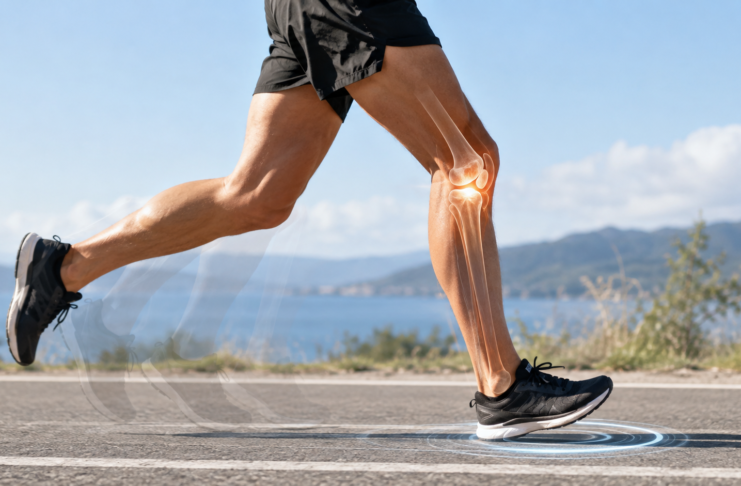
*New research shows that the way your foot strikes the ground while running may significantly influence stress on your ACL—and it matters more than you think.*
KEY STATISTICS
- Rearfoot striking during running produces measurably lower anterior cruciate ligament (ACL) loading compared to forefoot striking patterns.
- ACL injuries account for approximately 50% of all serious knee ligament injuries in active adults.
- Adults aged 35–45 often return to running after injury without understanding their individual strike pattern, increasing reinjury risk.
If you’ve ever felt a twinge in your knee while running, or worse—suffered an ACL injury—you’ve likely focused on rest, physical therapy, and gradual return to activity. But a growing body of biomechanical research suggests that how your foot actually contacts the ground during running may be one of the most overlooked factors in protecting your knee. A new musculoskeletal modeling study published in Frontiers in Sports and Active Living examined the relationship between running strike patterns and the forces acting on the ACL, revealing surprising insights about which landing style places less stress on this vulnerable ligament.
For runners in their late 30s and 40s, understanding this simple distinction could be the difference between a sustainable running habit and chronic knee problems.
The Science: Strike Pattern and ACL Load
The ACL is a ligament that prevents excessive forward movement of your shinbone relative to your thighbone—a critical function during the impact phase of running. Researchers used advanced musculoskeletal modeling to measure the internal forces on the ACL under different landing conditions. The study compared what happens to your knee when you land on your heel (rearfoot striking) versus landing more toward the middle or front of your foot (forefoot striking).
- Rearfoot striking distributes impact forces more gradually through the heel, reducing peak stress transmitted to the ACL.
- Forefoot striking concentrates more ground reaction force through the mid- and forefoot, creating higher instantaneous loads on the ACL.
- The ACL works hardest to stabilize the knee during the first 30% of ground contact—the critical window where strike pattern matters most.
- Computer modeling allows researchers to calculate internal ligament forces that cannot be measured directly during actual running.
Why Your Age Matters for Knee Stability
Adults between 35 and 45 occupy a unique risk zone: they’re old enough to have accumulated years of running wear and tear, yet active enough to continue high-impact activities. At this age, ligament tissue becomes gradually less elastic, recovery takes longer, and past injuries often leave residual instability. If you’ve already had an ACL problem, your current landing pattern directly determines how much additional stress you place on the healing or reconstructed ligament.
- Ligament elasticity naturally declines after 35, making the ACL less resilient to repetitive high-impact forces.
- Many runners in this age group return to running without gait analysis, unknowingly reinforcing risky landing patterns.
- Prior ACL injury or surgery increases vulnerability to secondary injury—strike pattern becomes a protective or risk factor.
- This decade is critical: establishing sustainable running mechanics now prevents chronic knee problems in your 50s.
Warning Signs to Watch For
- Sharp or catching pain on the inner or front of your knee during or immediately after running.
- Swelling that appears within hours of a run and persists for more than 24 hours.
- Instability sensation—feeling like your knee might ‘give way’ on uneven ground or during direction changes.
- Pain that worsens when landing from a jump or stopping suddenly, suggesting ACL stress under load.
- Limping or favoring one leg even days after running, a sign of ongoing inflammation or guarding.
- Recurrent knee pain in the same location after previous injury, indicating inadequate biomechanical correction.
What Actually Helps: Evidence-Based Adjustments
Changing your running strike pattern isn’t about forcing an unnatural motion—it’s about understanding your baseline and making gradual, evidence-based adjustments. The research suggests that rearfoot striking, when executed properly, places less stress on your ACL. However, this doesn’t mean abandoning your natural gait; rather, it means optimizing it.
- Video-record yourself running at normal pace; a gait analysis specialist or physical therapist can identify your current strike pattern objectively.
- Strengthen hip and glute muscles through targeted exercises—stronger hip stabilizers reduce compensatory stress on the knee ligaments.
- Increase cadence gradually (aim for 160–180 steps per minute) to reduce impact forces regardless of strike pattern.
- Incorporate calf and intrinsic foot strengthening; these muscles stabilize your ankle and reduce ACL loading during landing.
Your Action Plan This Week
- Schedule a gait analysis with a running specialist, physical therapist, or sports medicine clinic—don’t guess at your strike pattern.
- Document your baseline: note your current pain level, running distance, and frequency before making any changes.
- Begin a 4-week lower-body strengthening program focusing on hip abductors, hip external rotators, and single-leg stability.
- Reduce running volume by 20% while implementing any gait modifications to allow neuromuscular adaptation.
- Film yourself running every 2 weeks to track biomechanical changes; small adjustments take 6–8 weeks to feel natural.
- If pain persists or worsens, seek formal evaluation rather than self-correcting—individual anatomy varies, and one-size-fits-all advice can backfire.
The Overlooked Role of Fatigue Recovery
Most runners focus exclusively on conditioning and forget that muscle fatigue directly alters strike pattern. When your hips and glutes fatigue, your body often shifts toward a forefoot-dominant strike and loses stability—exactly when your ACL needs protection most. Sleep and recovery are therefore not peripheral concerns; they’re structural demands of knee safety.
- Fatigued muscles cannot stabilize joints effectively; poor sleep reduces muscular endurance and control by your next run.
- Running when sleep-deprived alters proprioception (your body’s sense of position), making unsafe landing patterns more likely.
- A full night of sleep (7–9 hours) enhances neuromuscular adaptation to gait changes, accelerating biomechanical improvement.
- Recovery days allow ligament remodeling; running hard on consecutive days prevents tissue adaptation and increases reinjury risk.
Bottom Line
Your running strike pattern is not set in stone—it’s a trainable habit that directly influences how much stress your ACL absorbs with every footfall. The research indicates that rearfoot striking produces lower ACL loading, but the key takeaway for your age group is simpler: understanding your baseline pattern, strengthening the muscles that stabilize your knee, and respecting recovery are the tools that determine whether running becomes a lifelong habit or a source of chronic pain. Small, evidence-based changes implemented consistently over weeks produce measurable results.
Live Long Daily — always consult a qualified healthcare provider before making changes to your health routine.
Sources
- Rearfoot striking is associated with lower modeled ACL loading during overground running: a musculoskeletal modeling study — Frontiers in Sports and Active Living
- General guidance on ACL injury risk factors and prevention — National Institutes of Health

