
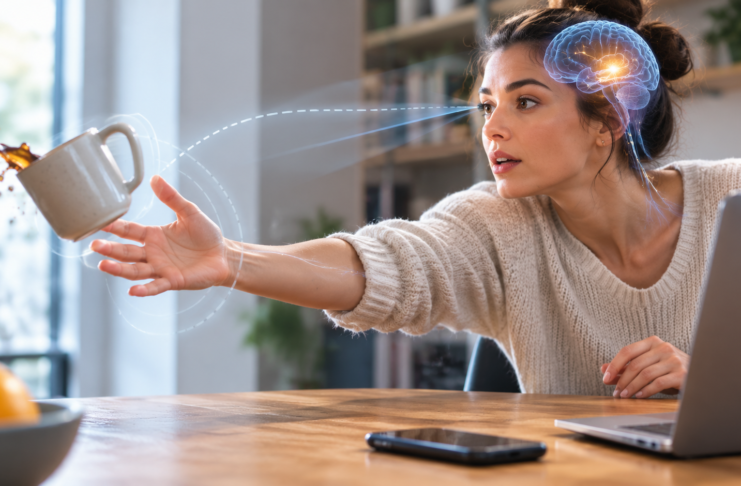
*How your nervous system anticipates movement—and why it matters after 35*
KEY STATISTICS
- The human brain generates predictive motor commands 100–200 milliseconds before conscious awareness of movement.
- Visuomotor anticipation—the ability to intercept moving targets—declines measurably starting in the late 30s without deliberate practice.
- Expert athletes and active older adults retain interception accuracy 20–30% higher than sedentary peers of the same age.
You catch a falling coffee mug without thinking. Your eyes track a tennis ball across the net. You reach for your phone mid-conversation without looking.
These split-second actions feel automatic, but they’re the result of a hidden neural calculation happening in real time. Your brain isn’t simply reacting to motion—it’s predicting where objects will be and commanding your body to intercept them before you’re even conscious of the decision. This predictive ability, called visuomotor expertise through interception, is one of the sharpest tools your nervous system possesses.
And after 35, it starts to fade unless you actively maintain it.
How Prediction Happens in Motion
Your brain doesn’t wait for your eyes to tell it where something is moving. Instead, it uses past experience, visual cues, and internal models of motion to forecast the future position of objects in real time. This predictive motor system involves multiple brain regions working in parallel—the cerebellum fine-tunes timing, the motor cortex generates movement commands, and the visual cortex processes incoming motion signals.
The entire loop happens in less than a quarter-second.
- Your motor system generates commands before conscious awareness, allowing fluid interception of fast-moving targets.
- The cerebellum compares predicted outcomes with actual sensory feedback, continuously updating your internal motion model.
- Visual motion cues (speed, direction, trajectory) feed into predictive calculations in the superior colliculus and parietal cortex.
- Repeated practice refines these neural predictions, making interception faster and more accurate.
Why Your 40s Are Critical
The machinery of visuomotor prediction begins to show measurable wear in your late 30s and 40s. Processing speed slows slightly, reaction times lengthen, and the cerebellum’s ability to update predictions in real time becomes less responsive. The decline is gradual and usually unnoticed in daily life—until you’re the one who fumbles the catch or hesitates crossing a busy street.
- Neural processing speed peaks in your 20s and begins a slow, steady decline around age 35.
- The cerebellum’s precision in updating motor predictions decreases with age, especially without regular motor challenges.
- Sedentary adults lose interception accuracy faster than active peers; the decline accelerates in the 40s without intervention.
- Age-related changes in eye-hand coordination compound when combined with reduced physical activity or poor sleep.
Signs Your Predictive System Is Slowing
- You miss catches or drop objects more frequently than you did five years ago.
- Crossing busy streets feels slightly more rushed; you’re less confident judging vehicle speed and distance.
- Video games or fast-paced sports require noticeably more concentration than they used to.
- You notice slower reflexes in driving situations—delayed braking or steering responses to unexpected obstacles.
- Hand-eye coordination tasks (threading a needle, precise manual work) feel less automatic and more effortful.
- Your balance falters slightly in unexpected situations; you’re slower to catch yourself if you stumble.
Proven Ways to Sharpen Prediction
Maintaining visuomotor prediction isn’t about fancy supplements or brain training apps. It’s about consistent motor challenge—activities that force your brain to predict and intercept moving objects. Sports, dynamic balance work, and even deliberate movement practice can sustain the neural circuits that keep your reactions sharp through your 40s and beyond.
- Racquet sports (tennis, badminton, pickleball) demand real-time visuomotor prediction and maintain neural processing speed.
- Martial arts and combat sports directly train predictive motor control under time pressure and fatigue.
- Dynamic balance exercises (single-leg stability work, unstable surfaces) engage the cerebellum’s predictive mechanisms.
- Consistent aerobic activity preserves neural processing speed and cerebral blood flow to prediction-relevant brain regions.
Start This Week: Action Plan
- Choose one racquet or ball sport and commit to 60 minutes weekly; prioritize moving, unpredictable targets over static drills.
- Add 2–3 sessions of dynamic balance or stability work: single-leg stance, bosu ball exercises, or balance beam walking.
- Practice hand-eye coordination drills: juggling, catching with a partner, or reaction-time apps 2–3 times per week.
- Maintain 150 minutes of moderate aerobic activity weekly; preserve the neural substrate that supports fast processing.
- Assess your current reaction time: use a simple online ruler-drop test monthly to track changes and stay motivated.
Sleep and Stress Shape Reflexes
Sleep quality and stress directly impact neural processing speed and the cerebellum’s ability to update predictions. When you’re sleep-deprived or chronically stressed, your reaction times slow and your predictive accuracy drops—often before you consciously notice the change. Protecting sleep becomes a performance tool, not just a wellness habit.
- Sleep deprivation slows visual processing and impairs cerebellar learning, making interception notably slower after poor sleep.
- Chronic stress elevates cortisol, which impairs the prefrontal cortex’s ability to coordinate with motor centers during prediction.
- Even one night of adequate sleep partially restores reaction time; consistency over weeks rebuilds predictive sharpness.
- Stress-reduction practices (meditation, breathing work) lower baseline arousal and improve cerebellar precision under pressure.
Bottom Line
Your predictive motor system is a high-precision tool that begins to dull in your late 30s. But unlike cognitive decline or metabolic slowdown, visuomotor expertise responds rapidly to the right kind of practice. Racquet sports, dynamic balance work, and consistent aerobic activity—combined with solid sleep and stress management—can preserve or even restore the quick reflexes and fluid movement that define physical confidence.
The neural machinery for lightning-fast prediction doesn’t disappear with age; it simply needs the right stimulus to stay sharp.
Live Long Daily — always consult a qualified healthcare provider before making changes to your health routine.
Sources
- Visuomotor expertise and interception in human movement science — Human Movement Science (PubMed)
- General information on aging and neurological function — NIH National Institute on Aging
- Sleep and cognitive performance — Mayo Clinic

