
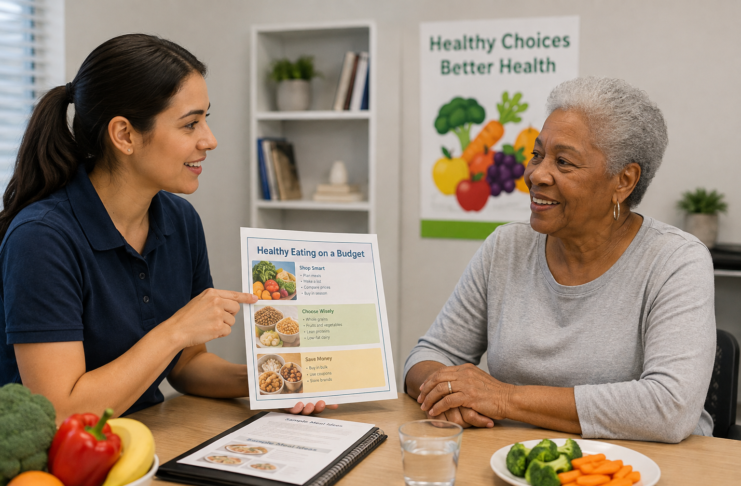
What research shows about reaching older adults with nutrition guidance—and why one-size-fits-all advice fails.
KEY STATISTICS
- Low-income older adults face unique barriers to accessing and engaging with nutrition education.
- Preferences for how nutrition information is delivered vary significantly by demographic and socioeconomic factors.
- In-person, tailored approaches show higher engagement than generic digital or written resources for this population.
You’ve likely heard the standard nutrition advice: eat more vegetables, choose whole grains, limit sodium. But if you’re a lower-income older adult—or caring for one—that generic guidance misses something crucial. A new study published in Annals of Medicine examined how older adults with limited financial resources actually prefer to receive nutrition education, and the findings challenge the assumption that one approach works for everyone.
The difference between what health professionals *think* will work and what actually reaches this population can mean the gap between good health and preventable decline.
The science behind delivery
Nutrition education isn’t simply about sharing information—it’s about how that information reaches people, resonates with them, and becomes actionable in their real lives. Research into delivery preferences reveals that older adults don’t absorb nutrition guidance uniformly, and low-income populations face distinct access and engagement barriers.
- Effectiveness of nutrition education depends partly on *how* it’s delivered, not just *what* is taught.
- Older adults show stronger engagement with approaches that feel personal and directly relevant to their circumstances.
- Low-income populations often experience barriers including limited internet access, transportation, and health literacy variation.
- Preferences shift based on cultural background, prior health experiences, and trust in the messenger.
Why income compounds the challenge
Older adults aged 60 and above with lower incomes face compounding challenges: fixed budgets that make healthy food expensive, chronic conditions requiring dietary management, and reduced mobility that limits access to in-person programs. Low-income status amplifies these challenges beyond what age alone creates.
- Nutritious foods often cost more per serving than processed alternatives, forcing budget-conscious choices.
- Reduced access to transportation limits ability to attend classes, workshops, or visit specialized clinics.
- Digital divides mean online nutrition programs exclude those without reliable internet or smartphones.
- Prior negative healthcare experiences create skepticism toward new nutrition messaging or unfamiliar educators.
Warning signs nutrition education isn’t reaching you
- Feeling confused by nutrition advice that doesn’t account for your food budget or access to stores.
- Receiving nutrition guidance in formats you can’t easily use (digital-only when you lack internet, for example).
- Being told to eat foods regularly that are impossible to afford or find in your neighborhood.
- Lack of follow-up or accountability after initial nutrition education; one-time advice without real support.
- Noticing your health isn’t improving despite trying to follow generic nutrition guidance that doesn’t fit your life.
- Feeling unheard when you explain barriers; educators dismissing cost, access, or time constraints.
- Receiving advice in a language you don’t fully understand or from someone unfamiliar with your cultural food traditions.
What actually moves the needle
Evidence shows that low-income older adults respond better to nutrition education that acknowledges their real constraints, uses trusted messengers, and offers practical—not just ideal—guidance. Successful approaches share common threads: they meet people where they are, rather than where nutrition experts think they should be.
- In-person group nutrition programs tailored to budget constraints outperform generic written or video materials.
- Educators from the same community or with lived experience of low-income constraints earn greater trust and engagement.
- Meal-specific, affordable guidance (how to stretch a dollar on vegetables, economical protein sources) beats theoretical nutrition principles.
- Programs that include food sampling, cooking demonstrations, or meal prep support show higher behavior change than education-only formats.
Action plan checklist
- Seek nutrition education specifically designed for older adults on limited budgets, not generic advice.
- Ask if programs offer in-person options, transportation assistance, or free meals—avoid digital-only if that’s a barrier for you.
- Request educators who understand food affordability, cultural preferences, and neighborhood food access realities.
- Look for programs that teach practical cooking and shopping skills, not just nutritional theory.
- Build accountability by joining group programs or finding a nutrition-focused peer who also wants to improve dietary habits.
- If cost is a barrier, ask about SNAP benefits expansion, food banks, and community garden programs.
- Request follow-up support and check-ins rather than one-time education sessions.
The overlooked power of trust
Social connection and trust are hidden factors that determine whether nutrition education actually sticks. Low-income older adults often navigate systems where they’ve felt dismissed or unheard; a nutrition educator who builds genuine relationship and demonstrates understanding of real-world constraints becomes far more influential than even excellent scientific content delivered impersonally.
- Peer-led nutrition programs (older adult teaching older adult) show stronger adoption than expert-led formats.
- Educators who acknowledge financial constraints and brainstorm solutions together earn credibility and engagement.
- Community settings (churches, senior centers, food banks) foster connection alongside education, improving retention.
Bottom Line
Nutrition education for low-income older adults isn’t a problem of willpower or motivation—it’s a problem of fit. When education is delivered in ways that acknowledge real budgets, offer practical alternatives, come from trusted messengers, and include social connection, behavior change becomes possible. If you’re navigating nutrition advice on a limited income, seek out programs built specifically for your reality, not your ideal circumstances.
Live Long Daily — always consult a qualified healthcare provider before making changes to your health routine.
Sources
- Preferences for nutrition education delivery among low-income older adults — Annals of Medicine
- General guidance on nutrition for older adults — CDC

