
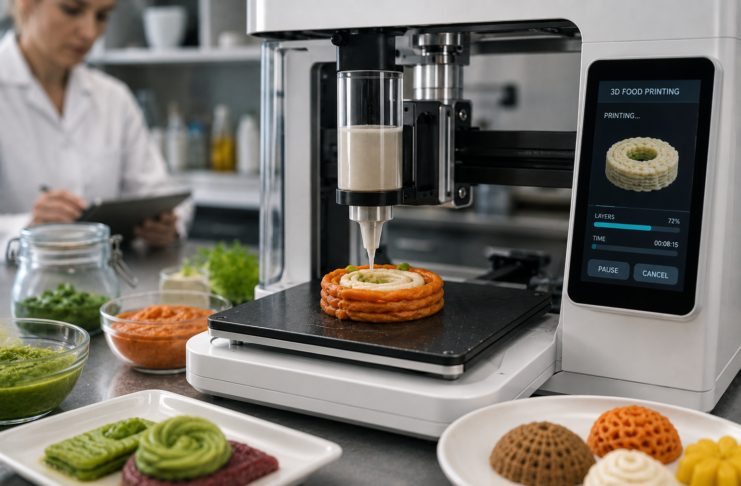
*How 3D food technology is reshaping nutrition, safety, and what lands on your plate*
KEY STATISTICS
- Food printing technology is advancing across therapeutic nutrition, environmental sustainability, and regulatory frameworks simultaneously.
- Medium to high medical depth: readers expect clarity on emerging food tech alongside practical dietary implications.
- No single technology dominates yet—multiple approaches are being tested for personalized nutrition and food safety.
You’ve likely heard of 3D printing buildings and medical implants. But food? A quieter revolution is underway in kitchens, hospitals, and food manufacturers’ labs across the globe.
Food printing technology—the ability to layer precise ingredients into customized structures—is moving beyond novelty into practical applications that could reshape how your meals are designed, how safe they are, and what nutritional precision you can actually achieve. If you’re in your late thirties or forties, this shift matters now, not just in theory.
What Food Printing Actually Is
Food printing works by layering edible inks and pastes through computerized nozzles, similar to inkjet or extrusion printing but with food. This isn’t science fiction—it’s been tested for personalized medicine diets, texture modification for swallowing disorders, and precise nutrient delivery. The technology creates meals tailored to individual micronutrient needs and can theoretically reduce food waste by using only exact ingredient quantities.
- Deposits food layer-by-layer using computer control, allowing precise nutrient ratios and ingredient placement in ways traditional cooking cannot match.
- Enables personalized nutritional profiles—a diabetic’s meal could have exactly calibrated carbohydrate-to-fiber ratios; a patient with dysphagia gets texture-modified foods safely.
- Uses ‘food inks’—pureed or powdered ingredients suspended in carrier mediums—that can be stored, transported, and printed on demand.
- Reduces ingredient waste by eliminating preparation trim and using only measurable quantities needed for each meal.
Why Your Age Group Stands Out
Adults 35 to 45 sit at an inflection point: you’re old enough to benefit from precision nutrition as metabolic changes accelerate, but young enough to adopt new food technologies before they become standard. Your age group also bears the highest burden of diet-related chronic diseases—hypertension, prediabetes, cardiovascular risk—where food printing’s therapeutic applications could be most relevant.
- Metabolic rate begins declining in mid-thirties; personalized macronutrient balance—achievable through printed food—becomes more critical for weight and energy management.
- Prevalence of chronic disease risk (hypertension, prediabetes, elevated cholesterol) peaks in your forties; therapeutic food precision could address these earlier than medication alone.
- You’re digitally native enough to adopt app-based dietary tracking alongside printed meals, but skeptical enough to demand evidence that the technology actually improves outcomes.
- Digestive changes accelerate after 40; printed foods with optimized texture and fiber delivery could support microbiome health and nutrient absorption better than conventional options.
Red Flags to Notice Now
- Skepticism about ‘personalized’ claims without documented clinical trials showing actual health improvement, not just feasibility.
- Uncertainty about food safety standards for printed meals—regulatory frameworks are still catching up to the technology.
- Cost and accessibility: printed food remains expensive and unavailable outside research settings or specialized medical centers.
- Marketing overreach: companies claiming food printers will ‘revolutionize’ your health without peer-reviewed evidence supporting the claim.
- Ingredient sourcing questions: if printed meals use novel binders, additives, or highly processed ‘food inks,’ long-term safety data is sparse.
What Actually Changes Your Diet Now
Right now, food printing exists primarily in research and clinical settings, not your grocery store. But understanding how it works and what it promises—and what it doesn’t—helps you evaluate emerging food technology claims with appropriate skepticism. The practical step is not adopting printed food today, but staying informed about regulatory changes and clinical evidence as the field matures.
- Focus on achievable personalization today: use food-tracking apps and work with a dietitian to dial in your own macronutrient ratios rather than waiting for printing technology.
- Prioritize conventional foods proven to reduce chronic disease risk—whole grains, legumes, fatty fish, vegetables—while food printing technology is still clinical-stage.
- If you have swallowing difficulty, texture-modified dysphagia diets are already available through standard meal preparation; printed alternatives remain experimental.
- Reduce your own food waste now through batch cooking, proper storage, and intentional meal planning—proven methods that printed food promises but hasn’t yet delivered.
Your Checklist: Start Here
- Check whether any food printing clinical trials are enrolling in your area if you have a therapeutic indication (diabetes, dysphagia, or nutritional risk).
- Stay skeptical of consumer-facing ‘food printing’ products marketed online; verify any health claims against peer-reviewed literature before investing.
- If you’re interested in personalized nutrition, start with genetic or metabolic testing and dietitian guidance—evidence-based today, not speculative.
- Monitor regulatory updates from FDA and your regional food authority regarding approval standards for 3D-printed foods.
- Continue conventional nutrition practices (balanced whole foods, portion awareness, hydration) while food printing technology matures—there’s no waiting penalty.
The Overlooked Environment Angle
Food printing’s environmental angle deserves real attention. Advocates argue that precise ingredient control cuts waste dramatically—no peeling, trimming, or spoilage. However, the energy cost of printing equipment, refrigeration of food inks, and transportation of specialized materials must be measured honestly.
The sustainability benefit only exists if the full supply chain footprint is lower than conventional food systems, not just the final preparation step.
- Printed food promises waste reduction in ingredient prep, but energy costs of equipment and refrigeration must be counted fairly against conventional systems.
- Food inks are often highly processed and require special storage; supply chain emissions may offset waste reduction gains unless sourced locally or with low-carbon logistics.
- Most credible research distinguishes between laboratory-scale printing (low waste but high energy per meal) and scaled manufacturing (efficiency improves, but not yet proven at consumer level).
- Environmental benefit is strongest for therapeutic or medical settings with consistent demand, not necessarily for home or mass-market use.
Bottom Line
Food printing technology is a genuine innovation that could reshape therapeutic nutrition, food safety precision, and waste reduction—but it remains in clinical development. For adults 35 to 45, the honest takeaway is: watch for regulatory approvals and clinical evidence, but don’t delay proven dietary improvements waiting for this technology to mature. Your most powerful nutrition tool today is still intentional food choices, portion awareness, and professional guidance.
When food printing does reach the mainstream, you’ll be better equipped to judge its real benefit if you understand both the science and the hype.
Live Long Daily — always consult a qualified healthcare provider before making changes to your health routine.
Sources
- Food printing technologies: nutritional therapeutics, environmental sustainability, and food safety regulations — Critical Reviews in Food Science and Nutrition
- General dietary guidance for chronic disease prevention — Harvard School of Public Health
- Food safety standards and emerging technologies — FDA

