
The shoes you trust most may be quietly dismantling the structural foundation of your entire body.
KEY STATISTICS
- Approximately 26% of adults develop flat feet or fallen arches by their 40s, according to research published in the Journal of Foot and Ankle Research.
- A 2021 study in Scientific Reports found that habitually barefoot populations show significantly greater intrinsic foot muscle strength and arch integrity than shod populations.
- The American Podiatric Medical Association reports that over 75% of Americans will experience a serious foot problem at some point in their lives, with arch collapse among the most common triggers
You lace up your supportive trainers every morning thinking you are protecting your feet — but the arch support built into those shoes may actually be doing the work your foot muscles should be doing themselves. By your late 30s and early 40s, years of motion-controlled footwear, hard flat floors, and sedentary routines have quietly weakened the 26 intrinsic muscles that hold your arch in place. The result is a slow structural collapse that sends pain rippling upward into your knees, hips, and lower back.
How Your Arch Works
Your foot arch is not a fixed bony structure — it is a dynamic spring system held in shape by muscles, tendons, and the plantar fascia, a thick band of connective tissue running along the sole. When these tissues are strong and engaged, the arch absorbs shock, transfers force efficiently, and keeps your entire kinetic chain aligned from ankle to spine.
When the intrinsic foot muscles are underused — which happens when cushioned shoes absorb impact on your behalf — they atrophy over time. Research published in the Journal of Biomechanics confirms that reduced muscle activation in the foot leads to measurable decreases in arch height under load, a process that accelerates with age and prolonged footwear use.
Barefoot walking on natural, uneven surfaces forces every small stabilising muscle in the foot to fire continuously, rebuilding the strength and proprioception that modern footwear has suppressed. A 2019 study in Scientific Reports demonstrated that just 16 weeks of progressive barefoot activity significantly increased flexor hallucis and abductor hallucis muscle volume — the two key muscles most responsible for maintaining medial arch height.
Why Midlife Feet Collapse
Between the ages of 35 and 45, several biological shifts converge to make fallen arches significantly more likely. Collagen production declines by roughly 1% per year after 30, meaning the plantar fascia and supporting ligaments lose elasticity and tensile strength precisely when lifestyle demands remain high.
Weight gain common in midlife adds compressive load directly onto a weakening arch. Even an extra 10 pounds increases the ground reaction force through the foot by up to 30% during walking, according to research from the Mayo Clinic.
Hormonal changes also play a role. In women approaching perimenopause, relaxin and estrogen fluctuations affect ligament laxity throughout the body, including the feet — making arch instability more pronounced during this decade than at any other point in adult life.
Warning Signs To Watch
- Heel pain or stiffness that is worst in the first few steps after waking — a hallmark sign of plantar fasciitis driven by arch strain
- Visible flattening of the inner arch when standing barefoot on a hard floor, with little to no gap between the sole and the surface
- Knee pain that tracks inward, particularly during stairs or downhill walking, caused by overpronation originating at a collapsed arch
- Chronic lower back ache with no clear spinal cause — often traced to altered gait mechanics stemming from poor arch support
- Shoe wear patterns showing excessive erosion on the inner heel and ball of the foot, indicating consistent overpronation with each stride
Movement Changes That Help
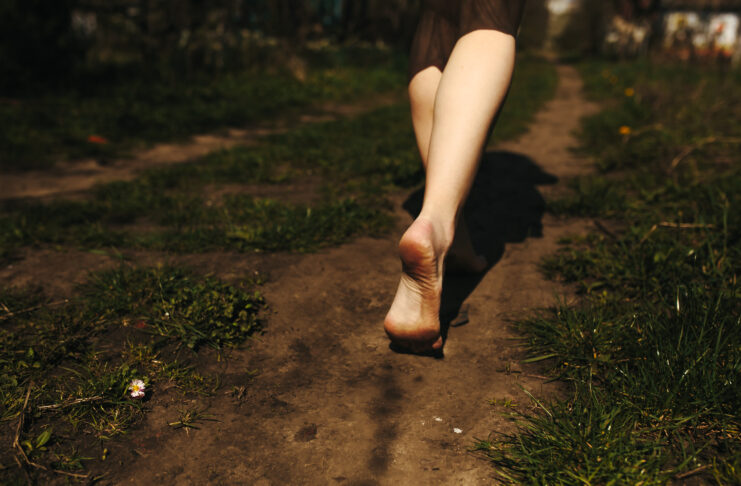
The most evidence-backed starting point is short, intentional barefoot sessions on grass, sand, or textured natural ground — not concrete. Natural uneven surfaces create micro-adjustments in foot position with every step, activating stabiliser muscles that flat indoor floors simply cannot engage.
Begin with five to ten minutes daily and increase by two to three minutes each week. Research from the University of the Witwatersrand found that gradual barefoot exposure over 12 weeks improved arch index scores without increasing injury risk when progression was controlled.
Complement barefoot walking with targeted exercises: short-foot exercises, where you draw the ball of the foot toward the heel without curling the toes, directly train the intrinsic muscles responsible for arch height. Toe-spread holds, single-leg calf raises on a slight incline, and towel-scrunching drills round out a programme that takes under ten minutes daily.
Minimalist footwear — shoes with zero heel drop, wide toe boxes, and thin flexible soles — can extend the rehabilitation effect into your regular day when going fully barefoot is not practical. Brands designed around biomechanical minimalism allow the foot to function more naturally without the abrupt transition shock of no footwear at all.
Your Arch Recovery Plan
- Start barefoot walking on grass or sand for 5–10 minutes daily, increasing duration by 2–3 minutes per week over 8 weeks
- Practice short-foot exercises daily: sitting or standing, draw the ball of your foot toward your heel, hold for 5 seconds, repeat 10 times each foot
- Do 3 sets of single-leg calf raises on a slight downward slope 4 times per week to build posterior tibial tendon strength that directly supports the arch
- Transition at least one pair of daily shoes to a zero-drop, wide toe-box minimalist shoe to extend foot muscle engagement throughout the day
- Have a gait analysis done by a sports physiotherapist or podiatrist to establish your current arch index and track measurable improvement at 12 weeks
The Hip Strength Connection
One factor almost nobody discusses is the role of hip weakness in fallen arches — and it is more direct than most people expect. When the gluteus medius and hip external rotators are weak, the femur internally rotates under load, pulling the knee inward and forcing the foot to pronate excessively with every step, collapsing the arch from the top down.
This means that rebuilding your arch without also addressing hip stability is incomplete rehabilitation. A 2020 study in the Journal of Orthopaedic and Sports Physical Therapy found that participants who combined hip strengthening with foot-intrinsic training showed significantly greater arch improvement than those who focused on foot exercises alone.
Adding lateral band walks, clamshells, and single-leg deadlifts to your weekly routine addresses the root biomechanical driver of arch collapse — not just the symptom visible in your foot. Think of arch restoration as a full-chain project, not a local foot fix.
Bottom Line
Fallen arches in your 30s and 40s are not inevitable, and they are not permanent — they are the predictable result of underused muscles that respond well to the right stimulus. Progressive barefoot exposure on natural surfaces, combined with targeted foot and hip strengthening, can measurably restore arch height and eliminate the chain of pain it causes. Start small, stay consistent, and your feet will do exactly what they were built to do.
Always consult a qualified healthcare provider before making changes to your health routine.
Sources
- Foot muscle morphology and function in habitually unshod versus shod populations — Scientific Reports
- Intrinsic foot muscle responses to progressive barefoot activity — Journal of Biomechanics
- Prevalence of flat foot and associated factors in adults — Journal of Foot and Ankle Research
- Hip abductor strength and its relationship to foot pronation and arch collapse — Journal of Orthopaedic and Sports Physical Therapy
- Effects of minimalist footwear and foot strengthening on arch morphology — British Journal of Sports Medicine

