
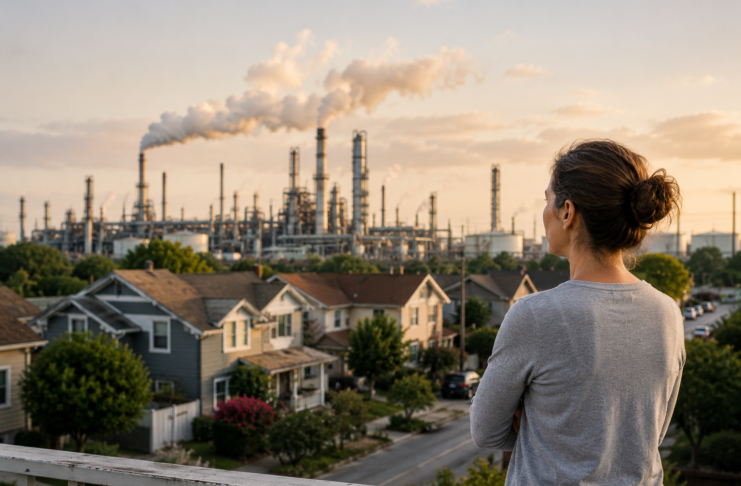
*What a community health study revealed about industrial proximity and your cancer risk at midlife*
KEY STATISTICS
- Industrial air pollution from refineries contains known carcinogens including benzene, formaldehyde, and particulate matter.
- Adults aged 35–45 face accumulated exposure risk from decades of living or working near emission sources.
- Proximity-based cancer risk studies show measurable differences in disease rates between high-exposure and control neighborhoods.
If you live within a few miles of an active refinery, a growing body of research suggests your cancer risk may be higher than you realized—and the danger isn’t theoretical. A recent community health study examined residents near Richmond’s Chevron refinery and found evidence linking proximity to industrial air pollution with elevated cancer rates. For adults in midlife, this matters urgently: you’ve likely accumulated years of exposure, and the time to take protective action is now.
The Science Behind Refinery Emissions
Industrial refineries release a cocktail of chemicals into the air that settle into soil and water and enter the body through inhalation and ingestion. Many of these substances—benzene, formaldehyde, and sulfur compounds—are classified as carcinogens or probable carcinogens by health agencies. When you live near a refinery, your lifetime exposure accumulates, raising your baseline cancer risk above that of people in less-exposed areas.
- Refineries emit volatile organic compounds and particulate matter that travel miles downwind and settle in residential areas.
- Benzene and formaldehyde are linked to leukemia and other blood cancers; chronic exposure increases risk over time.
- Proximity studies use modeling and health registry data to compare cancer incidence in high-exposure zones versus control areas.
- Industrial pollution doesn’t only cause cancer—it also worsens asthma, heart disease, and respiratory conditions across all ages.
Why Your Age Matters Most
Adults aged 35 to 45 are particularly vulnerable because you’ve spent decades—often since childhood—accumulating exposure near your home or workplace. This is the age when cancer risk begins to rise naturally due to aging, making added environmental hazard even more consequential. Your risk is compounded if you also face other factors like smoking history, family history of cancer, or occupational exposure.
- Cumulative exposure over 20–30 years amplifies cancer risk more than recent exposure alone.
- This age group often has settled into long-term housing—meaning you may not have considered relocation options available to younger adults.
- Cancer latency (the time between exposure and diagnosis) typically ranges 10–20 years, placing you at peak risk now.
- If you have school-age children, their ongoing exposure adds another layer of concern for your household.
Warning Signs to Monitor
- Persistent cough lasting more than 3 weeks, especially if you’ve never smoked or recently quit.
- Unexplained weight loss, fatigue, or night sweats over several months.
- Enlarged lymph nodes in the neck, armpit, or groin that don’t resolve within 2–3 weeks.
- Recurring infections, frequent nosebleeds, or unusual bruising (may signal blood cell changes).
- Abdominal swelling, persistent bloating, or changes in digestion lasting weeks.
- Skin changes—new moles, changes in existing moles, or persistent rashes in areas with sun exposure.
- Headaches, vision changes, or cognitive changes that feel new or worsening.
What Actually Reduces Your Risk
You cannot eliminate industrial air pollution through diet or exercise alone, but proven lifestyle interventions reduce your overall cancer risk and strengthen your body’s defenses. Combining these strategies with awareness of your environment gives you the best protection available at your control.
- Regular aerobic exercise (150 minutes weekly) lowers cancer risk across multiple types and boosts immune resilience.
- Plant-forward eating with high fiber intake is associated with lower colorectal and breast cancer risk.
- Limiting alcohol to no more than 1 drink daily for women, 2 for men reduces breast and colorectal cancer risk.
- Maintaining a healthy body weight reduces risk for postmenopausal breast, endometrial, and pancreatic cancers.
Your Action Checklist This Month
- Check your home’s location against your state or county’s industrial facility map; know your actual proximity in miles.
- Schedule a primary care visit to discuss your refinery proximity and establish a personalized cancer screening timeline.
- Improve home air quality: use HEPA furnace filters, seal gaps around windows and doors, and consider a HEPA air purifier for bedrooms.
- Track baseline health metrics now (weight, blood pressure, lipid panel) and repeat annually to catch early changes.
- Research local air quality data monthly via EPA AirNow or your state’s environmental agency—high pollution days warrant extra precautions.
- If relocation is feasible, prioritize moving away from the refinery corridor; if not, focus on the controllables above.
- Advocate for community air monitoring and industrial emission standards through local environmental or health departments.
Sleep, Stress, and Hidden Immunity Damage
Sleep quality and chronic stress both suppress immune function and have been linked to cancer development and progression. Living near an industrial facility—even if you don’t consciously notice the noise or smell—may disrupt sleep and elevate stress hormones. These often-overlooked factors matter as much as visible warning signs.
- Poor sleep (under 6 hours nightly) impairs natural killer cells, your body’s frontline defense against early cancer.
- Chronic stress elevates cortisol, which suppresses immune surveillance and may allow abnormal cells to escape detection.
- Industrial noise and light pollution near refineries disrupt circadian rhythm—aim for 7–9 hours of uninterrupted sleep.
- Stress-reduction practices (meditation, yoga, nature time) are evidence-based tools to restore immune function and lower cancer risk.
Bottom Line
Living near Richmond’s Chevron refinery—or any industrial facility—does carry documented cancer risk, but that risk is not inevitable. Your age (35–45) is the critical window to act: establish regular cancer screenings with your doctor, optimize the lifestyle factors under your control, and improve your home environment. Knowledge of your actual proximity combined with proactive health monitoring and stress management gives you agency in a situation that may otherwise feel powerless.
Live Long Daily — always consult a qualified healthcare provider before making changes to your health routine.
Sources
- Living near Richmond’s Chevron refinery could come with higher cancer risk, study says — Richmondside / Google News
- General guidance on environmental carcinogens and cancer prevention — National Cancer Institute / NIH
- Air pollution and cardiovascular/respiratory disease — CDC

