
Why personalized biomarker monitoring reveals what standard checkups miss—and how to start.
KEY STATISTICS
- Single-subject research protocols enable detection of individual health patterns invisible in population-level studies.
- Dynamic biomarkers shift daily based on stress, sleep, and lifestyle—static annual labs often miss these changes.
- Adults 35–45 show the earliest detectable shifts in metabolic and inflammatory markers linked to long-term resilience.
You get bloodwork once a year. Your doctor says everything looks normal. Yet you feel tired, struggle with focus, or notice your mood dips without clear reason.
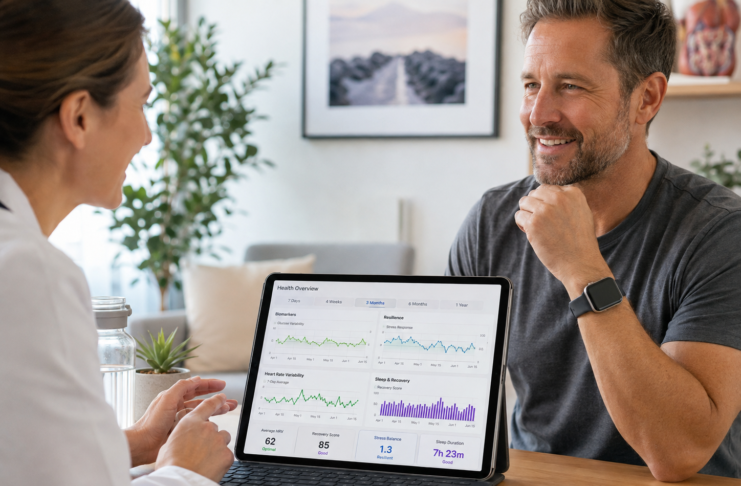
The problem isn’t your tests—it’s that they capture only a snapshot. A new framework called dynamic biomarker monitoring tracks your body’s real-time stress responses over weeks and months, revealing patterns that standard annual checkups simply cannot see. For adults in their late 30s and 40s, this personalized approach uncovers early warning signs of declining resilience before they become serious health problems.
The science behind biomarker shifts
Your body’s stress response isn’t static—it shifts minute to minute based on sleep quality, emotional load, exercise, and diet. Traditional biomarkers like cholesterol or glucose are typically measured once a year, missing the daily fluctuations that reflect your true physiological state. A dynamic, single-subject monitoring approach tracks your individual baseline and deviations from it, revealing patterns unique to you.
- Biomarkers (cortisol, inflammatory markers, glucose, heart rate variability) change daily in response to cumulative stress.
- Population-level studies show averages; N=1 protocols reveal your personal biological patterns and thresholds.
- Tracking multiple markers together—not in isolation—shows how stress, sleep, and nutrition interconnect in your body.
- Real-time data reveals lag effects: yesterday’s poor sleep affects today’s inflammation and mood regulation.
Why 35-45 is your pivotal decade
Your 40s are a critical window. Metabolic changes accelerate, hormonal shifts deepen, and chronic stress begins compounding. Yet most people don’t realize their resilience is eroding until a health crisis forces them to pay attention.
This age group benefits most from early detection because interventions now prevent much steeper declines later.
- Cortisol dysregulation accelerates in the 40s, affecting sleep quality, immune function, and metabolic rate.
- Inflammatory markers begin climbing subtly—invisible on annual labs but detectable through regular monitoring.
- Hormonal transitions (perimenopause, andropause) create individualized stress signatures not visible in younger adults.
- Early intervention at this stage prevents progression to metabolic syndrome, chronic fatigue, or mood disorders.
Signs your resilience may be declining
- Persistent fatigue despite adequate sleep—suggests inflammation or metabolic dysregulation.
- Mood instability or afternoon energy crashes—often linked to cortisol timing or glucose volatility.
- Slower recovery from exercise or illness—marks reduced biological resilience and immune capacity.
- Sleep that feels unrefreshing or frequent night wakings—indicates autonomic nervous system imbalance.
- Increased susceptibility to colds or recurrent infections—signals compromised immune regulation.
- Brain fog or difficulty concentrating, especially mid-afternoon—reflects metabolic or inflammatory stress response.
What actually shifts your biomarkers
Strengthening resilience means moving beyond one-size-fits-all advice. When you track your own biomarkers over time, you discover which interventions actually work for your body—not just what experts say should work. The most effective changes are those tailored to your personal patterns.
- Sleep consistency matters more than duration: regular 7-hour sleep beats irregular 9-hour sleep for cortisol stability.
- Stress recovery is measurable: meditation, walks, or social connection reduce inflammatory markers within hours to days.
- Protein and stable carbs stabilize glucose and cortisol patterns better than processed foods—visible in 2-3 weeks.
- Exercise timing affects recovery: morning activity supports cortisol rhythms; evening timing may disrupt sleep-linked markers.
Your biomarker monitoring checklist
- Establish baseline: Measure 3-5 key markers (cortisol, inflammatory markers, fasting glucose, heart rate variability) weekly for 4 weeks.
- Track stress and lifestyle daily: Log sleep hours, exercise, mood, meals, and stress level alongside biomarker results.
- Identify your personal patterns: Look for correlations—e.g., does poor sleep raise inflammation? Does exercise timing affect next-day fatigue?
- Test one intervention at a time: Change one habit (sleep schedule, exercise, diet) for 2-3 weeks and measure the biomarker response.
- Adjust based on data, not rules: If your markers improve with evening walks but worsen with morning runs, prioritize walks.
- Recheck quarterly: Retest key markers every 3 months to confirm trends and catch early shifts.
- Work with a provider: Share your tracking data with your doctor to refine medication, supplementation, or lifestyle prescriptions.
The overlooked stress-resilience link
Most people focus on diet and exercise while ignoring stress recovery. Yet cortisol dysregulation—driven by unmanaged psychological stress—undermines every other health effort. When you monitor stress-responsive markers, you realize that what feels like a small annoyance is creating measurable biological damage.
- Chronic stress elevates cortisol and inflammatory markers even when diet and exercise are optimized.
- Heart rate variability (HRV) is a sensitive stress marker: low HRV signals autonomic dysregulation and poor recovery capacity.
- Stress-reducing practices (breathwork, meditation, social connection) lower inflammatory markers within days—faster than diet changes.
- Tracking stress alongside biomarkers reveals your personal recovery time: some need 1 day off weekly; others need daily practices.
Bottom Line
You don’t need to wait for annual bloodwork or a health crisis to understand your body’s stress signals. A personalized biomarker tracking protocol—measuring your individual baselines and changes over weeks—reveals patterns that standard checkups miss. For adults in their 40s, this early detection is transformative: you gain concrete data about what actually works for your body, catch declining resilience before it becomes serious, and make evidence-based changes tailored to your unique biology rather than generic health advice.
Live Long Daily — always consult a qualified healthcare provider before making changes to your health routine.
Sources
- DELTA: Strengthening human biological resilience with an N=1 digital health and dynamic biomarker protocol — PLoS One
- General guidance on stress, resilience, and biomarker monitoring — NIH — National Institute of Mental Health

