
The sequence you apply your under-eye products determines whether they work — or quietly cancel each other out.
KEY STATISTICS
- The skin under your eyes is 0.5mm thick — roughly 10 times thinner than skin on the rest of your face, making penetration order critical.
- A 2021 study in the Journal of Cosmetic Dermatology found that applying vitamin C after retinol reduced its effective absorption by up to 40%.
- By age 35, collagen production drops by approximately 1% per year, meaning misdirected actives waste your skin’s narrowing repair window.
You have spent real money on that peptide eye cream and that vitamin C brightener, and you apply both every single morning. But if you are layering them in the wrong order, you may be getting close to zero benefit from at least one of them — and possibly irritating the most delicate skin on your face in the process.
Why Sequence Changes Everything
The under-eye area operates by different rules than the rest of your face. Skin here has fewer oil glands, almost no subcutaneous fat padding, and a barrier function that is measurably more permeable — which sounds like a good thing until you realise it also means ingredients interact faster and more aggressively than anywhere else.
Active skincare ingredients have specific pH ranges at which they are chemically stable and effective. Vitamin C, for example, works optimally at a pH between 2. 5 and 3.
5. Retinol and peptide complexes function closer to a neutral pH of 5 to 7. When you apply them in the wrong order, the first product temporarily shifts the skin’s surface pH, and the second product lands in a chemical environment it was not formulated for.
This is not a marketing myth — it is basic cosmetic chemistry. The result is not always visible irritation. More often it is silent inactivation: the product sits on the surface, looks absorbed, and does almost nothing.
Why Your 35+ Eyes Suffer
After 35, the under-eye skin undergoes a convergence of changes that make product sequencing more consequential than it was in your twenties. Cellular turnover slows, meaning active ingredients have fewer fresh skin cells to work with — and wasted applications represent wasted regeneration opportunities.
The lymphatic drainage around the eye socket also becomes less efficient with age. This means that products that sit unabsorbed on the surface are more likely to contribute to morning puffiness rather than overnight repair.
Hormonal shifts in this decade — particularly declining estrogen — reduce the skin’s natural moisture-retention capacity. This makes the sequence of hydrating versus active products even more important, because applying a hydrating barrier before a treatment serum physically blocks penetration.
Signs Your Routine Is Failing
- Persistent puffiness that does not resolve by mid-morning, suggesting products are sitting on the surface rather than absorbing
- Subtle stinging or tightness after applying your second under-eye product — a sign of pH conflict between two actives
- Darkening or uneven tone that seems to worsen despite using a brightening product regularly
- Tiny milia (white cysts) forming under the eye, often caused by heavy creams applied over actives that haven’t fully absorbed
- Your brightening or firming product seems to stop working after a few weeks — likely because it’s being consistently neutralised before it can act
The Correct Layering Order
The correct layering sequence for under-eye products follows one clear principle: thinnest consistency to thickest, lowest pH to highest, actives before occlusives. In practice, this means your vitamin C serum or brightening treatment goes on first, on clean dry skin, and waits a full 60 seconds before anything else touches that area.
After your vitamin C has settled, a peptide serum or retinol-based treatment can be applied — never the reverse. Applying retinol first creates a surface environment that destabilises ascorbic acid, rendering your vitamin C largely inactive on contact.
Your eye cream — typically the thickest product — goes on last. It acts as a seal, locking in the actives and providing the occlusive moisture layer the under-eye skin genuinely needs overnight. In the morning, skip retinol entirely under the eyes and use only your vitamin C followed by a light SPF-containing eye cream.
One often-missed step is the waiting time. Most people apply products back to back within seconds. A 45-to-60-second pause between each layer allows the skin’s surface pH to partially reset and gives each product a clear absorption window without competition.
Your Eye Routine Checklist
- ☐ Apply under-eye vitamin C serum first on clean, dry skin — wait 60 full seconds before layering anything else
- ☐ Follow with peptide or retinol treatment (evenings only) — never apply retinol before vitamin C in the same routine
- ☐ Finish with your eye cream as the final, thickest layer to seal in actives and provide occlusive hydration
- ☐ In your morning routine, skip retinol under the eyes and use vitamin C followed by an SPF-rated eye cream only
- ☐ Audit your current products for pH compatibility — if both list pH below 4, alternate them on different days rather than stacking them
The Technique Nobody Mentions
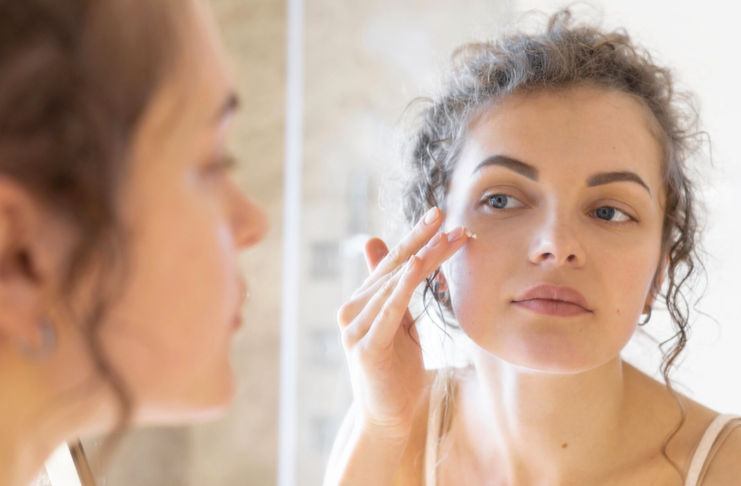
There is one overlooked factor that undermines even a perfect layering routine: application technique. Most people tap or rub eye products in immediately after dispensing, which physically moves the previous layer before it has bonded to the skin surface.
The correct method is to dispense your product onto your ring finger, allow it to warm for three seconds, then press — not rub — gently along the orbital bone. This distributes the product without disrupting the layer beneath it.
Temperature also matters more than most realise. Storing vitamin C eye serums in the fridge not only extends their stability but slightly constricts surface capillaries on application, temporarily reducing puffiness and improving the skin’s receptiveness to the next layer. It is a small habit with a measurable morning payoff.
Bottom Line
The under-eye routine you already have may contain excellent ingredients — the problem is the order they are meeting your skin. Correct the sequence, add a 60-second wait between layers, and press rather than rub, and you will likely see more result from the products you already own than from any new purchase.
Always consult a qualified healthcare provider before making changes to your health routine.
Sources
- Stability and effectiveness of topical vitamin C formulations in relation to skin pH — Journal of Cosmetic Dermatology
- Interactions between topical retinoids and ascorbic acid derivatives in cosmetic formulation — International Journal of Cosmetic Science
- Age-related changes in periorbital skin structure and barrier function — British Journal of Dermatology
- Collagen synthesis and degradation across decades: implications for topical intervention — JAMA Dermatology

