
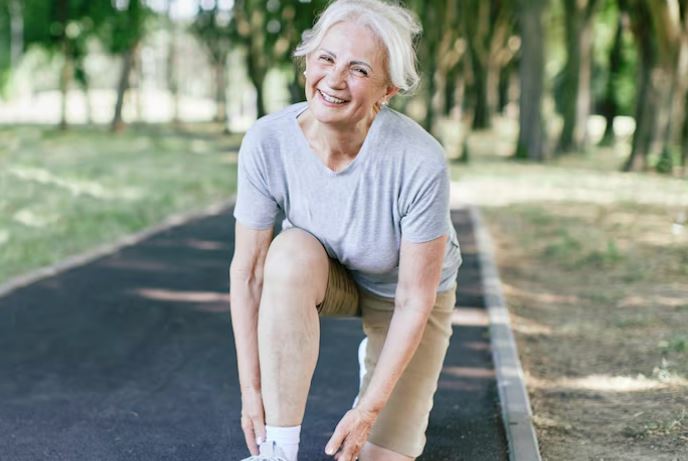
Recreational running after 35 quietly degrades knee cartilage — but the right gait fixes can protect your joints without giving up the miles.
KEY STATISTICS
- Runners over 35 are 3x more likely to develop patellofemoral pain syndrome than runners in their 20s, according to research published in the British Journal of Sports Medicine.
- Knee cartilage loses roughly 10% of its water content per decade after age 30, reducing its ability to absorb impact with every stride, per NIH-funded research.
- A 2022 study in the Journal of Orthopaedic Research found that overstriding — landing heel-first too far ahead of the body — increases knee joint load by up to 34%.
You signed up for a 5K because running felt like the responsible, healthy thing to do — and it is, mostly. But if you’re running the same way you did at 22, your knees are quietly paying a tax you won’t notice until it’s overdue. The damage isn’t dramatic; it’s cumulative, and it’s preventable.
What Running Does Inside
Every time your foot strikes the ground during a run, a force equal to two to three times your body weight travels through your knee joint. Healthy cartilage — the rubbery tissue covering the ends of your femur and tibia — acts as a shock absorber, distributing that load evenly across the joint surface.
Cartilage has no blood supply of its own. It feeds on synovial fluid, which is pumped in and out through movement, meaning it depends entirely on the mechanics of how you move to stay nourished and intact.
When gait mechanics are poor — overstriding, excessive heel striking, or collapsing inward at the knee — the load becomes uneven. Concentrated pressure on one section of cartilage accelerates breakdown faster than the tissue can repair itself.
Over months and years, this creates a pattern of microtrauma. The cartilage thins, becomes less elastic, and begins to fray at its edges — a process called chondromalacia — which is often the precursor to osteoarthritis.
Why 35-45 Is the Danger Window
Between ages 35 and 45, the body sits in a metabolic crossroads. Estrogen and testosterone levels begin their gradual decline, and both hormones play a direct role in maintaining cartilage integrity and reducing joint inflammation.
At the same time, muscle recovery slows noticeably. Micro-tears in the quadriceps, hamstrings, and hip stabilizers that once resolved overnight now linger for 48 to 72 hours — meaning many recreational runners are training on fatigued muscles that can no longer protect the knee joint properly.
This age group is also where running ambition tends to outpace physical preparation. Many adults in their late 30s and early 40s return to running after years away, or ramp up mileage quickly after a desk-job lifestyle, without rebuilding the supporting musculature first.
The result is a joint being asked to absorb high impact loads with less hormonal support, less muscle backup, and cartilage that is already 10 to 15 years into its natural aging curve.
Warning Signs to Watch For
- A dull ache behind or around the kneecap that appears during or after runs but feels fine at rest — classic early patellofemoral syndrome
- Stiffness in the knee for more than 20 minutes after sitting for long periods, especially the morning after a run
- A grinding, clicking, or crunching sensation felt — not just heard — when bending or extending the knee under load
- Swelling around the knee joint that persists for more than 24 hours after a run, even without a specific injury event
- Pain that worsens going downstairs or downhill, which places the highest compressive load on the patellofemoral joint
Gait and Lifestyle Fixes That Work
The single most impactful change most recreational runners can make is shortening their stride. Increasing cadence by 5 to 10 steps per minute — while keeping pace the same — shifts ground contact closer to your center of mass, dramatically reducing the braking force that hammers the knee with each step.
Midfoot striking, landing with the foot roughly beneath the hip rather than out in front of it, redistributes impact more evenly across the ankle, knee, and hip. You don’t need to become a forefoot runner; landing flat under your body is enough to reduce knee load significantly.
Strength training is non-negotiable at this age. Two sessions per week targeting the glutes, single-leg quads, and hip abductors directly reduces knee valgus collapse — the inward buckling that concentrates pressure on the medial cartilage.
Running surface matters more after 35 than it did before. Grass and packed trail absorb roughly 30% more impact than concrete. Rotating between surfaces across your weekly runs gives cartilage time to recover between harder efforts.
Your Joint Protection Action Plan
- Use a metronome app to increase your running cadence to 170-180 steps per minute — count your steps for 30 seconds and multiply by 4 to get your baseline
- Add two lower-body strength sessions per week: prioritise single-leg squats, glute bridges, and lateral band walks before adding any other exercises
- Reduce weekly mileage by 10% for two weeks, then rebuild gradually — this is the standard sports medicine protocol for resetting overuse patterns
- Replace at least one road run per week with trail or grass to cut cumulative impact load on cartilage
- Book a single session with a running physio or gait analyst — video analysis identifies your specific fault pattern faster than any general advice
The Sleep Factor Nobody Mentions
There is a recovery variable almost no recreational runner tracks: sleep quality. During deep slow-wave sleep, the body releases the majority of its daily growth hormone output, which is the primary driver of cartilage matrix repair and soft tissue recovery.
Adults aged 35 to 45 average 20 to 25% less slow-wave sleep than they did in their 20s, according to research from the National Sleep Foundation. That reduction directly impairs the overnight repair cycle that running cartilage depends on.
If you are running four or five days a week on six hours of fragmented sleep, you are almost certainly accumulating a cartilage repair deficit — even if your gait is perfect. Prioritising seven to eight hours of sleep is not a lifestyle luxury; for a runner in this age window, it is a structural joint intervention.
Cooling your bedroom to between 65 and 68°F, avoiding screens for 45 minutes before bed, and keeping a consistent wake time are the three changes with the strongest evidence for improving slow-wave sleep depth in middle-aged adults.
Bottom Line
Running after 35 is not the problem — running with the same mechanics, the same mileage approach, and the same recovery habits you had at 22 is. Small, specific adjustments to stride length, strength training, surface selection, and sleep can extend your running life by decades. Your knees don’t need you to stop; they need you to adapt.
Always consult a qualified healthcare provider before making changes to your health routine.
Sources
- Patellofemoral pain in recreational runners: risk factors and biomechanical contributors — British Journal of Sports Medicine
- Articular cartilage aging and the role of mechanical loading in chondrocyte metabolism — Journal of Orthopaedic Research
- Running biomechanics and lower extremity injury risk: a systematic review — British Journal of Sports Medicine
- Sleep and musculoskeletal recovery in aging athletes — National Institutes of Health — NIH.gov
- Strength training for knee osteoarthritis prevention in middle-aged adults — Mayo Clinic Proceedings

