
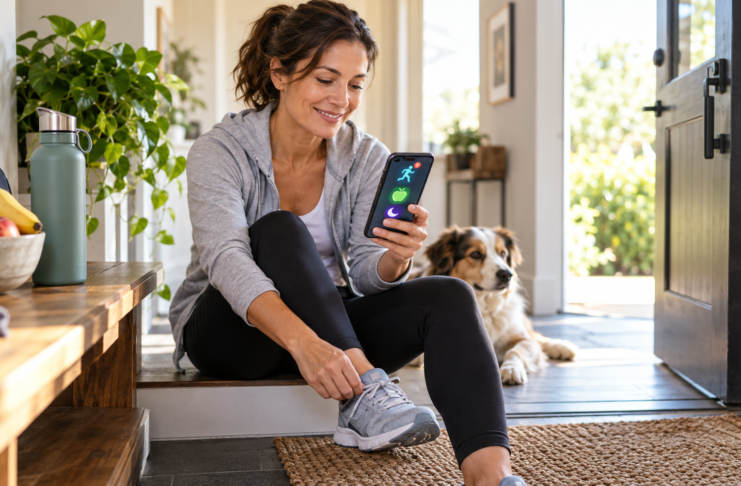
*How smart notifications actually rewire behavior—and whether they work for you*
KEY STATISTICS
- Digital reminders and push notifications are evidence-based tools shown to support behavior change in lifestyle medicine.
- The effect of digital nudges depends heavily on how they’re designed—generic alerts work far less than personalized ones.
- Young adults aged 25–35 respond differently to digital nudges than older populations, partly due to smartphone integration in daily life.
You’ve probably ignored dozens of app notifications today. But what if a few of them were actually designed to help you eat better, move more, or sleep on schedule—and they actually worked? The myth is that digital nudges are just annoying pop-ups with no real power.
The truth is more nuanced: when built the right way, they can shift your behavior. A recent scoping review published in *Frontiers in Digital Health* examined how digital nudging techniques actually function in lifestyle medicine and what makes some nudges effective while others fade into the background.
What Digital Nudging Really Is
Digital nudging is the practice of using app notifications, messages, or interface design to gently encourage a specific health behavior. Unlike a forceful reminder, a nudge works by making the desired choice easier or more visible—without removing your freedom to ignore it. Understanding how these tools work at a behavioral level helps you decide whether they’ll actually serve you.
- A nudge uses design or messaging to make a healthy choice feel natural, not forced.
- Effective nudges rely on behavioral psychology—timing, framing, and personalization matter more than frequency.
- The goal is to lower friction: fewer steps between deciding to act and actually acting.
Why Your Age Matters Here
Your age group has a unique relationship with digital nudging. You’ve grown up with smartphones and are more likely to have apps installed; you’re also more likely to notice and trust nudges that feel authentic rather than corporate. But that same familiarity can make poorly designed nudges invisible—or worse, annoying.
- Adults 25–35 respond better to nudges embedded in apps they already use daily.
- Overly frequent or generic notifications lose effectiveness faster in this age group due to notification fatigue.
- Social proof and peer-based nudges tend to resonate more with younger adults than authority-based ones.
Signs a Digital Nudge Isn’t Working
- You automatically swipe away notifications without reading them—the nudge has become invisible noise.
- The notification arrives at a time when acting on it is genuinely difficult (e.g., a ‘move’ reminder during a meeting).
- You feel resentful or manipulated by the message, even if the behavior itself is healthful.
- The nudge doesn’t acknowledge your actual circumstances (one-size-fits-all prompts rarely stick).
- You’ve seen the same nudge so many times it no longer registers as new information.
Digital Nudges That Actually Work
Research suggests the most effective digital nudges combine timing, personalization, and behavioral science. Simply getting more reminders won’t work—the design of the reminder and the context in which you receive it matter far more. Here’s what actually supports lasting change.
- Personalized nudges (based on your habits, preferences, or past behavior) outperform generic mass-message alerts.
- Timing is critical: nudges land best just before a natural decision point in your day.
- Visual feedback (progress bars, charts, streak counters) often outperforms text-only reminders for sustained engagement.
Build Your Nudge Strategy
- Audit your current app notifications: which ones make you act, and which do you ignore?
- Choose one health goal and one app—start with single, high-value nudge rather than multiple overlapping reminders.
- Adjust timing: set notifications for when you’re most likely to act (e.g., hydration reminders mid-morning, not at 6 AM).
- Enable personalization settings if available—let the app learn your patterns rather than treating you generically.
- Review weekly: if a nudge hasn’t moved your behavior after two weeks, remove it and try a different approach.
The Psychology Behind the Message
One overlooked factor in digital nudging is *framing*—how the message is worded. Research shows people respond more strongly to nudges framed around what they gain (positive framing) versus what they lose (loss framing), but the effect varies by person and context. Your own psychology matters as much as the nudge’s design.
- Loss-framed nudges (‘You’ll miss your step goal today’) work better for some people; gain-framed ones (‘Complete 3 more stretches’) for others.
- Nudges that include social comparison (‘Your friends averaged 8,000 steps’) can motivate or demoralize depending on your baseline and mindset.
- Intrinsic motivation (nudges that align with *why* you care) creates longer-lasting behavior change than external pressure.
Bottom Line
Digital nudging isn’t magic, and it’s not manipulation—when done well, it’s a practical tool that lowers the friction between intention and action. The key is choosing nudges that fit *your* life, timing, and psychology, not fighting every notification your phone sends. If you’re serious about a health change, a well-designed nudge can be a small but real ally.
Just remember: the nudge only opens the door; you still have to walk through it.
365 Live Long — always consult a qualified healthcare provider before making changes to your health routine.
Sources
- Digital nudging techniques for behaviour change in lifestyle medicine: a scoping review — Frontiers in Digital Health

