
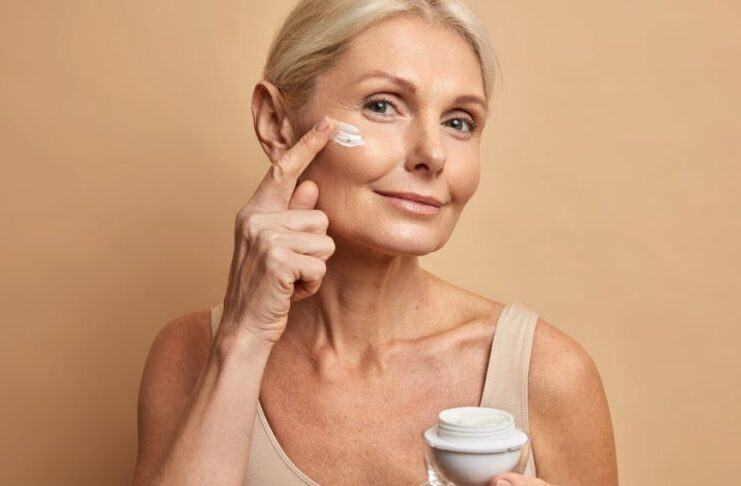
The water coming out of your tap may be quietly destroying your skin barrier — and the damage shows up first around your eyes and mouth.
KEY STATISTICS
- 85% of U.S. homes receive hard water, according to the U.S. Geological Survey.
- Research published in the Journal of Investigative Dermatology found that hard water exposure significantly increases skin surface pH, weakening the skin barrier by up to 25%.
- A study in the International Journal of Cosmetic Science found that calcium and magnesium deposits from hard water measurably reduce the effectiveness of moisturizers by nearly 30%.
You’ve tried the serums, you sleep on your back, you drink your water — and yet the fine lines around your eyes keep deepening and the skin around your mouth feels perpetually dry and dull. The culprit might not be your skincare routine at all. It could be the water you’re washing your face with every single morning and night.
What Hard Water Does
Hard water contains elevated concentrations of dissolved minerals, primarily calcium and magnesium. When this water contacts your skin, these minerals don’t rinse away cleanly — they leave behind a microscopic residue that sits on the skin’s surface.
This mineral film disrupts the skin’s acid mantle, the thin protective layer that keeps moisture in and bacteria out. When the acid mantle is compromised, the skin’s pH rises, and the environment needed for healthy barrier function breaks down.
Calcium ions from hard water have been shown to interfere with the enzyme activity required for proper skin cell turnover. Dead cells accumulate rather than shedding efficiently, leaving skin looking dull and textured.
The minerals also bind to the surfactants in your cleanser, reducing its ability to rinse cleanly. This means a film of soap-mineral compound is left on your skin after every wash, clogging pores and provoking low-grade inflammation.
Why Your 30s Matter
Between the ages of 35 and 45, the skin’s natural lipid production begins to slow, making the barrier inherently less resilient than it was a decade earlier. This means cumulative mineral damage from hard water has far less natural repair capacity to counteract it.
Collagen production declines at roughly 1% per year after your mid-thirties. When a compromised skin barrier allows transepidermal water loss to increase, the collagen and elastin beneath the surface degrade faster under oxidative stress.
The periorbital area — the skin around your eyes — and the perioral area — around your mouth — are biologically thinner and produce less sebum than the rest of your face. These zones are the first to show barrier damage as visible fine lines, persistent dryness, and a crepe-like texture.
Signs To Watch For
- Persistent tightness or dryness around the mouth and eyes even after moisturising
- Fine lines around the lips and outer corners of the eyes that deepen rapidly
- A dull, chalky residue or tight feeling on the skin immediately after washing
- Increased skin sensitivity, redness, or mild itching that worsens after showering
- Moisturisers and serums that seem to stop working or absorb poorly over time
Changes That Actually Help
The single most effective intervention is installing a shower or tap filter with ion-exchange technology, which replaces calcium and magnesium ions with sodium ions before the water reaches your skin. These filters are widely available and can reduce mineral hardness by up to 90%.
If a filter isn’t immediately accessible, washing your face with filtered or bottled water stored in a clean vessel is a practical short-term fix. It feels inconvenient, but the difference in skin texture within two weeks is often noticeable.
Switching to a pH-balanced, soap-free cleanser matters more than most people realise. Traditional soap bars and many foaming cleansers already disrupt the skin’s acid mantle — combine them with hard water and you’re doubling the damage.
Applying a ceramide-rich moisturiser immediately after patting skin dry — within 60 seconds — helps seal the barrier before mineral residue can continue to affect pH. Ceramides are the structural lipids that form the skin barrier itself, and replenishing them topically directly counters the breakdown caused by mineral exposure.
Your Action Plan
- Install an ion-exchange shower or tap filter rated for calcium and magnesium removal
- Switch your facial cleanser to a pH-balanced, soap-free, fragrance-free formula
- Apply a ceramide-rich moisturiser within 60 seconds of patting your face dry
- Add a gentle daily exfoliant — lactic acid works well — two to three times per week to clear mineral-related buildup without stripping the barrier
- Run a humidifier in your bedroom overnight to counteract transepidermal water loss worsened by hard water exposure
The Overlooked Serum Factor
There is one factor almost no one considers: the role hard water plays in undermining your vitamin C serum. Vitamin C oxidises rapidly in the presence of metal ions — and hard water deposits calcium and magnesium ions directly onto the skin’s surface before you apply anything.
This means your expensive antioxidant serum may be partially deactivated before it even begins to absorb. If you’ve been using a vitamin C product for months without visible brightening or collagen support, hard water interference is a legitimate explanation.
Applying your vitamin C serum after cleansing with filtered water — or adding a few drops of a chelating toner that binds residual minerals — can restore the serum’s effectiveness considerably. This small sequencing change can make your existing products perform the way they were formulated to.
Bottom Line
Hard water is a daily, invisible stressor on your skin barrier that accelerates the exact signs of aging you’re trying to prevent — dryness, fine lines, and dullness around the eyes and mouth. The fix is not another serum. It starts with the water itself.
Filter it, adjust your routine around it, and your skin will respond faster than you expect.
Always consult a qualified healthcare provider before making changes to your health routine.
Sources
- The effect of water hardness on skin barrier function and atopic eczema — Journal of Investigative Dermatology
- Hard water and skin: calcium and magnesium ion effects on transepidermal water loss — International Journal of Cosmetic Science
- Skin pH and the acid mantle: significance for barrier function and skin conditions — Dermatology (Karger)
- Ceramide deficiency and its role in the compromised skin barrier — British Journal of Dermatology

